

Manhunt Season 1 Episode 4 Review: The Secret Line
Edwin Stanton makes some big moves in his search for John Wilkes Booth on Manhunt Season 1 Episode 4, ‘The Secret Line.”
Stanton’s primary goal on “The Secret Line” is to obtain information from businessman and Confederacy sympathizer George Sanders. Secretary Stanton believes Sanders is the best lead he has to catch Booth.
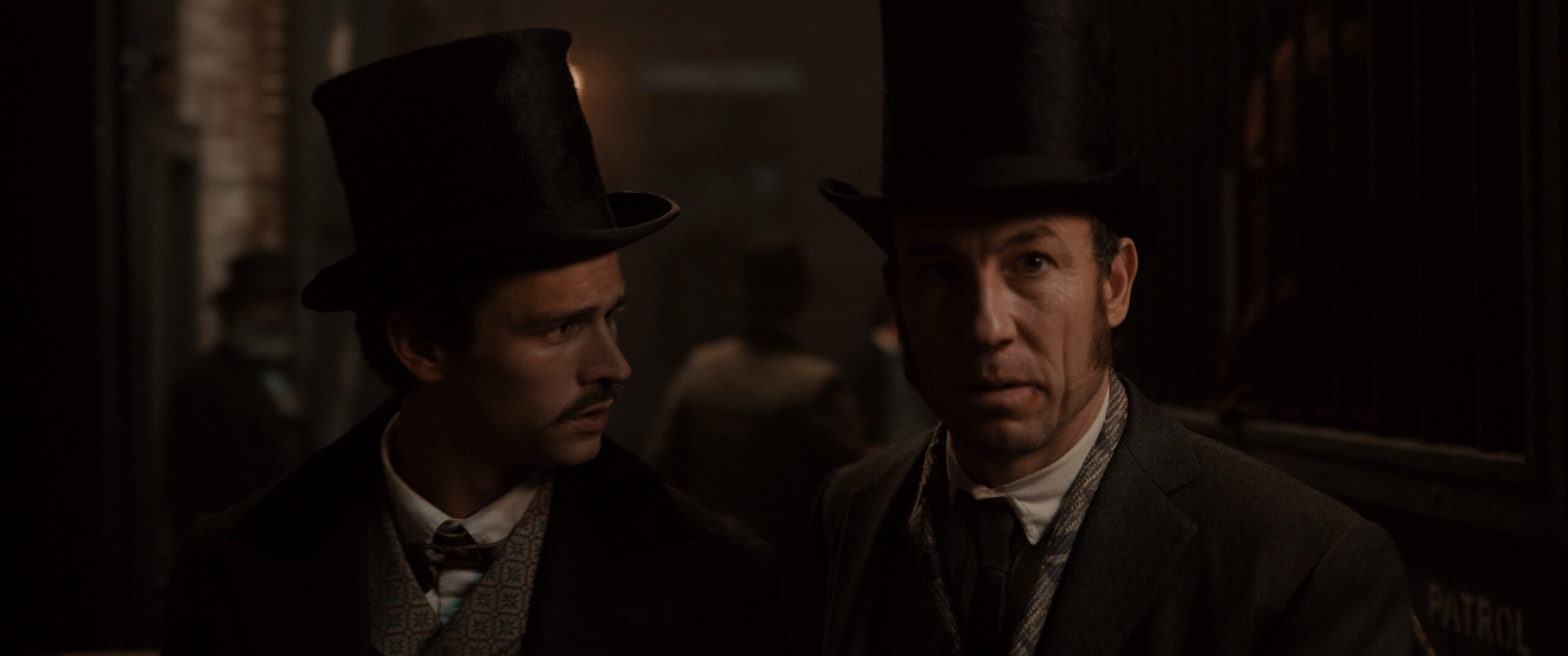
The problem is that Stanton doesn’t have leverage on Sanders. The man is able to work the system to get around the law regardless of how terrible his crime is.
A flashback even shows Sanders as responsible for an act of terrorism in New York during the war. Something for which they were never able to hold him accountable despite ample evidence of his involvement.
So, it’s a “the more things change, the more they stay the same” situation. Truth be told, the series makes it quite obvious that they are trying to draw parallels between then and now.
It can sometimes be a bit heavy-handed in its attempts to make those connections. For example, Sanders’s line about shooting Stanton on Wall Street is a pretty unsubtle allusion to Donald Trump.

Overall, “The Secret Line” makes these connections much more smoothly than the earlier episodes. They feel more organic, even the Trumpesque line, whereas on earlier episodes, those moments feel shoehorned in.
To gain the leverage he needs, Stanton makes his first big move: He orders a raid on a group of wealthy robber barons. These money men are betting against the US dollar and on southern gold and cotton instead.
More relevant to Stanton’s investigation is that they are also funding Sanders. Arresting them for betting against the dollar is just a pretext to put pressure on them to give up what they know about Sanders.
The raid works, and Stanton gets information about Sanders, even if unrelated to his connection with Booth. The information he gets is more political in nature regarding Andrew Johnson and his deal with Sanders.
It doesn’t initially seem like something that gets him any closer to Booth. However, Stanton uses that information to make his next big move, which just might.
Stanton uses the information he gets from his former father-in-law (one of the men arrested in the raid) to set up a meeting with Sanders. The pretense of that meeting is to make a deal for information on Booth or the network of Confederate agents he would go to for help.
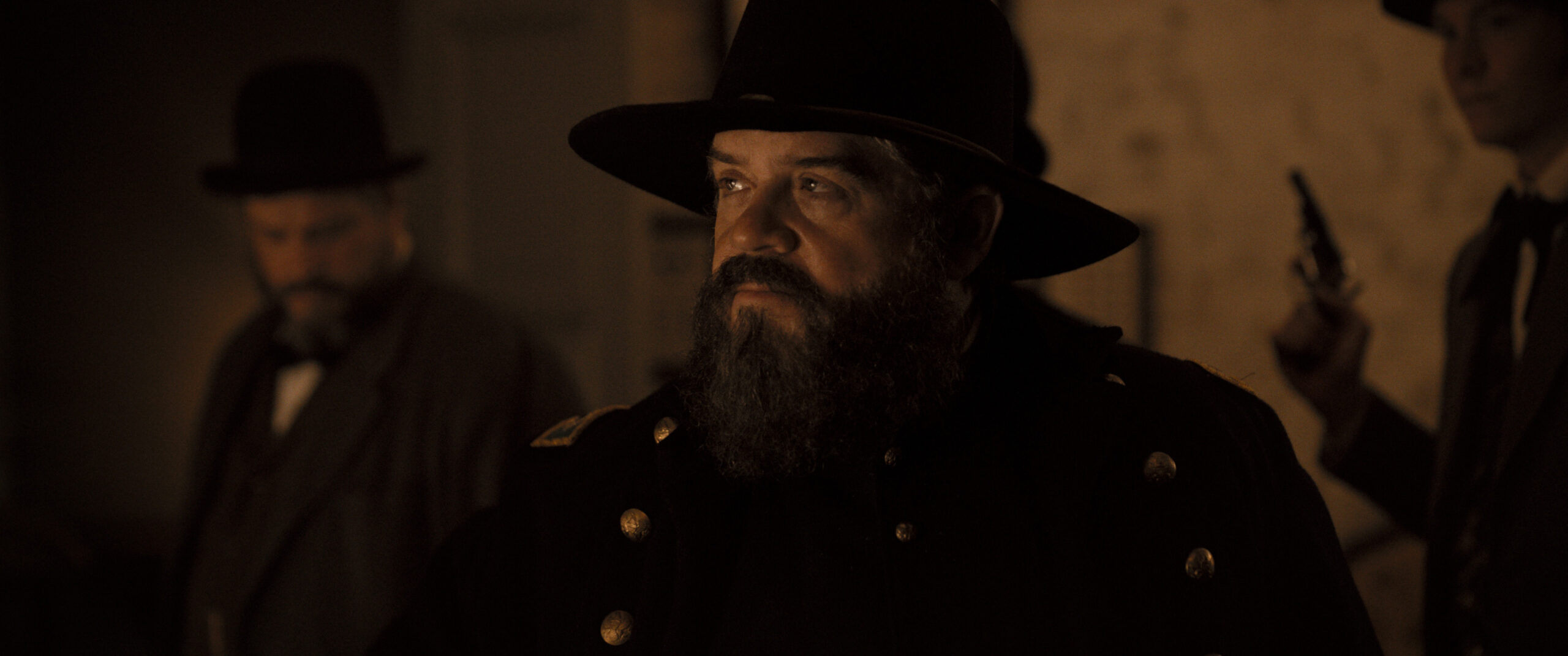
Sanders doesn’t play ball, though. Instead, he pulls a gun on Stanton, a move that gives Stanton a reason to arrest him. We don’t know yet if Sanders will evade accountability for his activtivites again. His wealth and influence may well insulate him. Still, it is pretty satisfying to see him led off in handcuffs.
But even if Stanton has to let Sanders go, his move to arrest him has already borne important fruit. First, it reveals Wallace as a double (or I guess triple) agent and removes that security risk.

More importantly, though, Sanders’s arrest allows Stanton to search his office. As a result, he finally secures a map of the Confederate network Booth is using on the run. Booth doesn’t know it, but the walls are closing in on him.
“The Secret Line” is much more successful than Manhunt Season 1 Episode 3, “Let the Sheep Flee.”
The main reason for this is that “The Secret Line” finally has the tension and intrigue of the political thriller viewers were promised in the series’ trailers.
The series is at its best when it focuses on Stanton’s search for Booth and explores the larger themes through that storyline, which is what most of “The Secret Line” does.
For example, “The Secret Line” does an excellent job of showcasing the white supremacy of the North and the way Northern industrialists benefited from slavery through the conspiracy with Sanders.It is much more effective than the confrontation between the Black Union soldiers and white locals on “Let the Sheep Flee.”
Even the scenes on “The Secret Line” that aren’t related to Booth or Stanton’s search for him work much better than they do on “Let the Sheep Flee.”
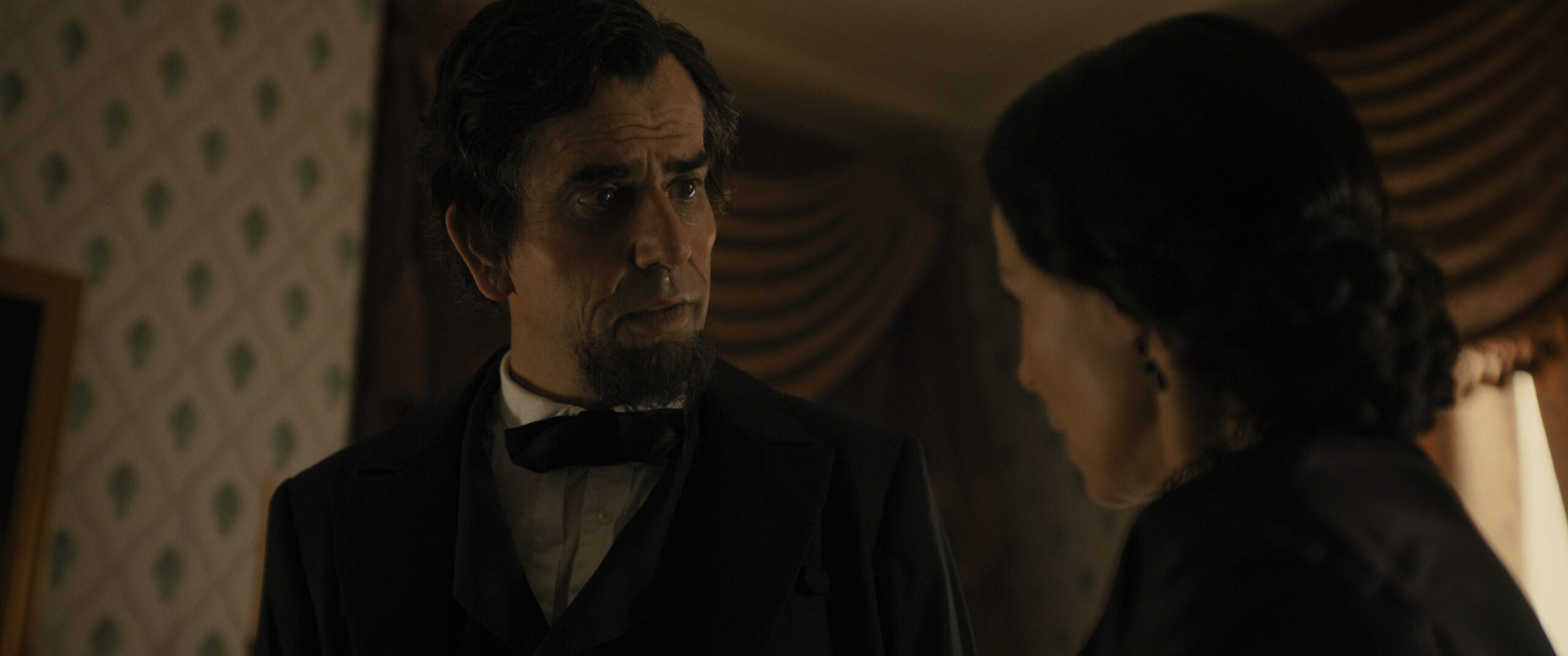
The flashback with Mary Todd Lincoln asking her husband not to let their son join the army is perhaps the best flashback scene the series has given us so far.
That scene also highlights another reason “The Secret Line” is much more successful. The scene seems to be pretty obviously a fictionalized version of events. I highly doubt that specific conversation happened (please correct me in the comments if I’m wrong).

But that example of creative license doesn’t feel egregious the way, say, the made-up meeting between Fredrick Douglas, Abraham Lincoln, and Edwin Stanton does on “Let the Sheep Flee.”
Part of that is simply because, as already discussed, this episode feels more like a political thriller than a dramatization of historical events. There is just more of a baked-in expectation that the priority is the drama rather than the history.
More than that, though, the conversation with Mary Todd Lincoln captures a truth about these people, their relationships, and what they went through. That specific conversation might not have happened, but conversations like it between Abe and Mary almost certainly did.
Unlike the scene with Fredrick Douglas on “Let the Sheep Flee,” which paints his relationship with Lincoln as closer and less adversarial than it actually was, the scene with Mary Todd Lincoln offers insight into the historical figure through a fictionalized account.
I hope the rest of the season brings us episodes like “The Secret Line,” which is the gripping historical thriller we’ve been waiting for.
What did you think of this episode of Manhunt? Share your thoughts in the comments below!
Critic Rating:
User Rating:
Manhunt streams Fridays on Apple TV+.
 Follow us on Twitter and on
  Instagram!
Want more from Tell-Tale TV? Subscribe to our newsletter here!
Sarah Fields

Sarah is an obsessive geek who likes to get into the weeds and over think things. She is passionate about Sci-Fi and comics and is a giant classic film nerd. Sarah cares deeply about media representation and the power of telling diverse stories. When she's not writing or watching her favorite shows she spends her days working in the non-profit world trying to make life a little better for those that need some extra help.