

False Positive Review: Psychological Horror Film is Poorly Conceived
Note: this review contains minor spoilers for False Positive.
Grisly, gory, and occasionally sharp, False Positive, Ilana Glazer’s newest brainchild, is a big ole zero.
The film starts with some promise. The script reflects some familiarity with the anxiety of infertility, the absurdities of pregnancy and mommy-culture, and the undercurrents of toxic masculinity in the workplace.
Anchored by a brilliantly calibrated and creepy/suave performance by Pierce Brosnan in the key role of fertility “savior” Dr. Hindle, and some smart snapshots of Lucy’s (Ilana Glazer) attempts to rise up in her male-dominated workplace, there’s a brief sense that perhaps False Positive is headed in an unexpected direction.
Rather than going the way of Rosemary’s Baby, perhaps the film is going to be more of a horror-comedy or satirical-thriller (think Freaky, Get Out, or The Hunt) with a focus on calling out misogyny awaiting women at every turn, including but not limited to the experience of pregnancy and birth.
But alas, False Positive can’t quite commit to consistently offering sharp social commentary and instead tries to pepper its humor with shocks, spooks, and double takes.
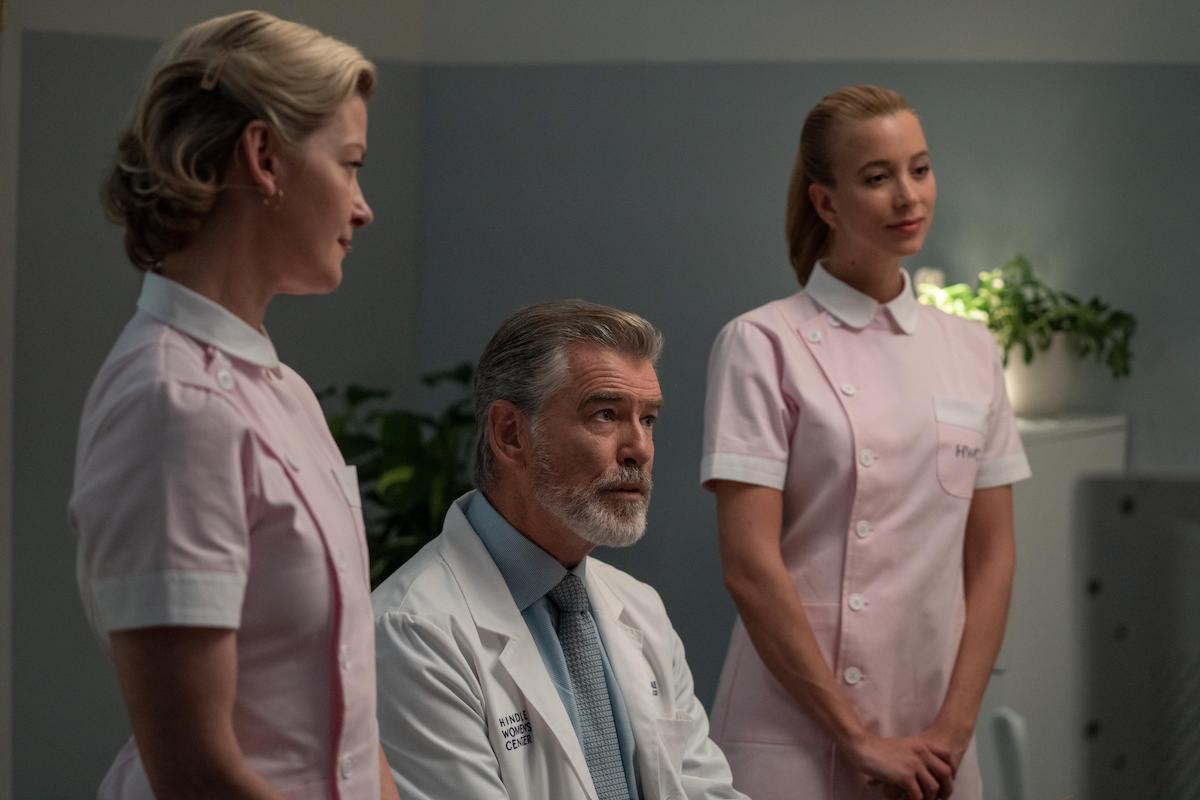
The result is muddled and unfocused.
There are moments where you can almost see what could have been, the better film that exists somewhere within the film we got.
While that’s worth acknowledging, I have to review the movie that we got, and the movie we got is…pretty bad (but mercifully, also relatively short).
The script is the main problem, often proving to be too heavy handed.
A Dig Inn reference that feels like it could have fit in well on any millennial workplace comedy, never builds to anything greater and just gets repeated, and the foreshadowing of Dr. Hindle’s medical abuse — and essentially rape — are easy to clock miles away.
While I enjoying taking credit for catching those references as they come along, there’s also something disconcerting about noticing most of the hints to the big reveal of a horror film in real-time.
The obvious telegraphing of information suggests a lack of trust in the audience or a basic ineptitude in plotting a story. Either way you slice it, it’s not great.
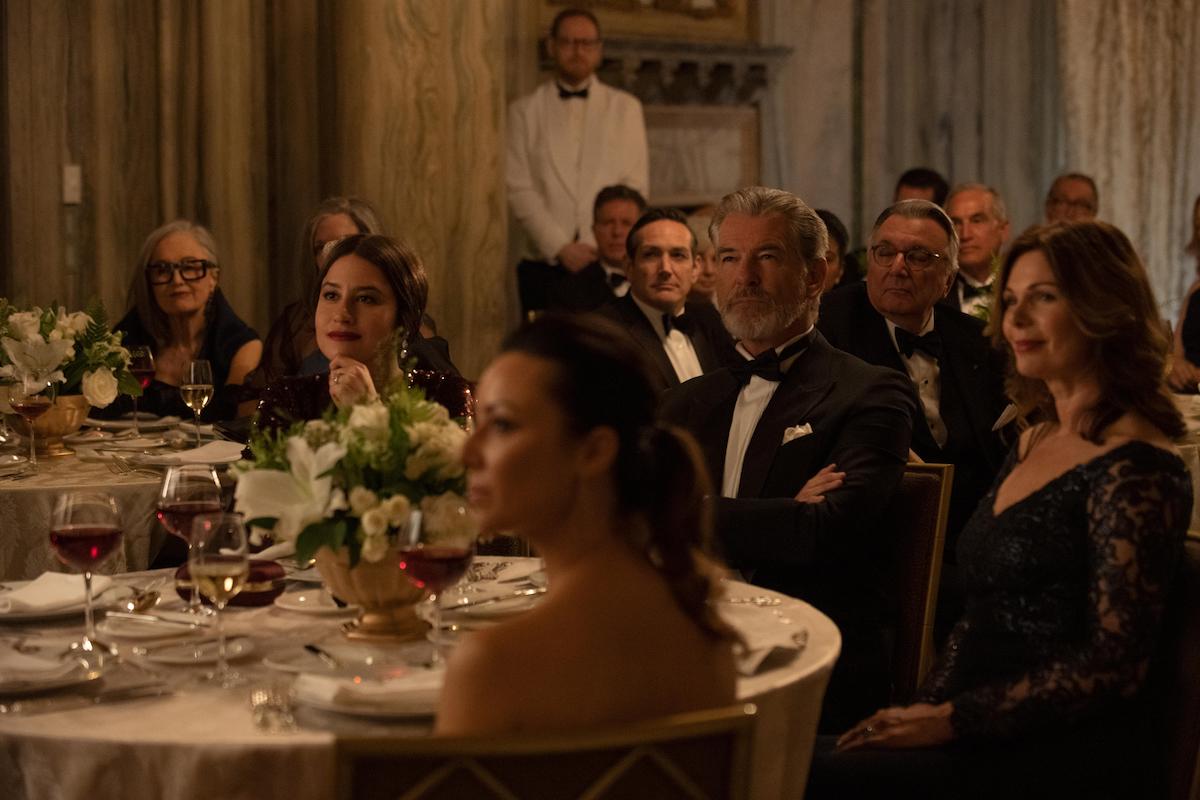
And then there’s that ending.
A lot of the film hinges on us being on Lucy’s side as she starts to feel betrayed by everything around her — her husband, her doctor, her friend, and just as importantly, her body.
It’s insinuated that Lucy is being gaslit and while we know next to nothing about Lucy as a person (more on that in a moment), she’s still our heroine. Why wouldn’t we believe her?
The conclusion of False Positive is a mess in so many ways. It’s macabre, bloody, surreal, and finally, totally trippy and disturbing. Its mishmash of tones is emblematic of the problem with the entire movie, but what it does to Lucy is almost unforgivable.
“Mommy brain” is a term I’ve heard thrown around quite a bit over the years, and it gains traction here too, an explanation for much of Lucy’s anxieties, concerns, and behavior.
This initially feels like an obnoxious way to disregard her valid worries and observations, but the ending throws that into complete disarray, suggesting she is in fact mentally unstable.
This is deeply, profoundly disappointing, essentially undermining so much of what’s come before it. Furthermore, it warps the definition of “mommy brain” and weaponizes it.
What in the movie did she imagine vs. what actually happened? It makes everything, especially the moments where False Positive does allow Lucy to fight back at the paternalistic, misogynistic situations she finds herself in, feel emptier.

Perhaps none of this should be surprising. After all, we never get a chance to know much about Lucy. She’s not developed as a full, well-rounded character, and the one major personal thing we learn about her — that her mother recently passed away — is clearly important to her character and her motherhood journey but is treated as almost a throw away line (truly, blink and you’ll miss it).
Her relationship with husband Adrian (Justin Theroux) is similarly faintly sketched.
We don’t learn anything about their life together outside of or before this pregnancy and other than idolizing Dr. Hindle, Adrian doesn’t have much in the way of distinguishing traits. (Oh, I guess he likes his exercise bike. Is that a personality trait?)
Since its characters are given little in the way of an internal life, it follows that the film wouldn’t concern itself too much with what it means to upend its lead character’s reliability (in what first appears to be a feminist allegory no less!)
But for a film that spends its run time balking at people invalidating and chipping away at Lucy’s autonomy, it sure is a slap in the face to feel like the film betrays her too in its conclusion.
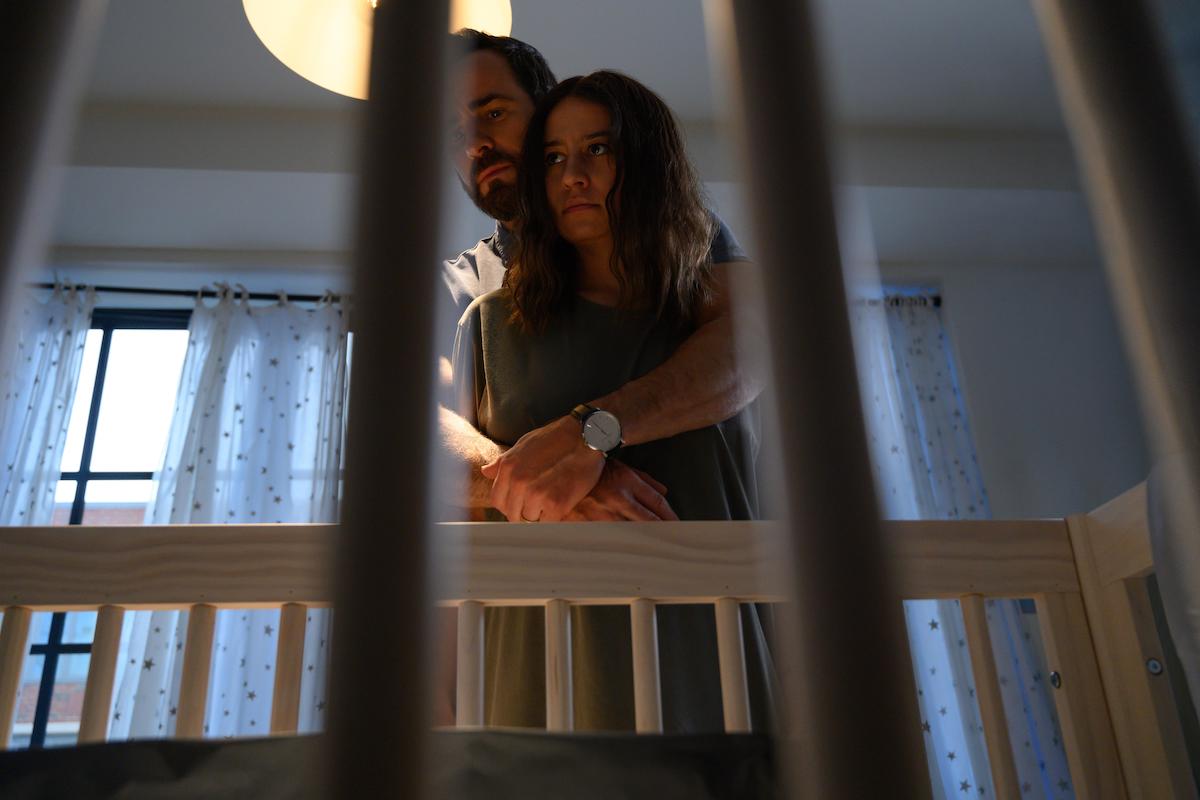
There are a lot of things to debate about the film, particularly the end sequence. There’s the reversal of the “Magical Negro trope” that feels clever but also confusing, and the recurring, eventually sinister Peter Pan motif.
Plus, knowing that Lucy is reeling from her mother’s death, is it possible the entire pregnancy and aftermath a delusion while she is working through her grief/trauma and longing for an escape?
Is her rejection of her (and Dr. Hindle’s) sons in favor of her dead daughter Wendy indicative of her strength (and rejection of Hindle’s invasion of her body) or a sad indicator of how far removed from reality she is?
To be clear, False Positive isn’t a satisfying movie, and it presents far more ideas and stories than it could ever come close to exploring in a substantial way. But as you can see above, it does prompt a lot of questions, (namely “why why why”) and that is, ahem, a positive thing, I suppose.
What did you think of False Positive? Share your thoughts in the comments below!
Critic Rating:
User Rating:
False Positive is available to stream on Hulu.
 Follow us on Twitter and on
  Instagram!
Want more from Tell-Tale TV? Subscribe to our newsletter here!
Cristina Iskander

Cristina is a Broadway enthusiast, book lover, and pop-culture fanatic living in New York City. She once won a Fantasy Bachelor contest (yes, like Fantasy Football, but for The Bachelor), and can banter about old school WB (Pacey + Joey FTW) just as well as Stranger Things and Pen15. She's still upset Benson and Stabler never got together and is worried Rollins and Carisi are headed down the same road, wants justice for Shangela, and hopes to one day walk-and-talk down a hallway with Aaron Sorkin.