

The Spanish Princess Review: Plague (Season 2 Episode 5)
The impact of Catherine’s struggles to produce an heir for England dominates The Spanish Princess Season 2 Episode 5, “Plague,” and the show’s careful and nuanced depiction of the pain of infertility is truly something that many other dramas could learn from.
Often, in retellings of Catherine’s life, only her failure is remembered — the uncomfortable fact of it, the desperation it left Henry in, the fact that her inability to have a son ultimately leads to her downfall.
Few versions, if any, even mention, let alone truly wrestle with the actuality of her infertility — how much pain her repeated miscarriages cause her, how isolated her losses leave her in the world of her own court, and how deeply hurt she is by Henry’s insistence that her failures are all her fault.
The Spanish Princess has done right by Catherine of Aragon in so many ways, but none so much as in legitimizing the pain she experiences and allowing her to express it without judgment or blame.

The scene in this episode in which she wrestles with her all too human jealousy and anger over Bessie’s pregnancy, as well as her own guilt over ill-wishing the woman who has what she herself can never seem to grasp, is knock-it-out of the park good.
And Charlotte Hope’s performance is layered and nuanced enough to convey a multitude of emotions all at once. She’s so darn good at playing a Catherine that’s torn between a half-dozen feelings at any given moment, each of which is always underlined by her understanding of the reality of her situation.
In almost every way imaginable, the real Catherine was a remarkable woman, and her depiction in The Spanish Princess reflects that. Educated, intelligent, passionate, and brave, she was everything a woman of her time could have ever aspired to be. And yet, it is her failure to have a son for which she is predominately remembered.
In the time of the Tudors, if a woman could not do her duty by her husband and give him a son and heir, she was essentially worthless. How much more so must that be true if that woman was a queen, who carried the weight of the monarchy’s hopes on her shoulders.
And in a country like England, whose subjects could easily remember the civil war for the throne that preceded Henry’s father? The lack of a son is dangerous, and both she and Henry clearly know that. The pressure must be nigh unimaginable.
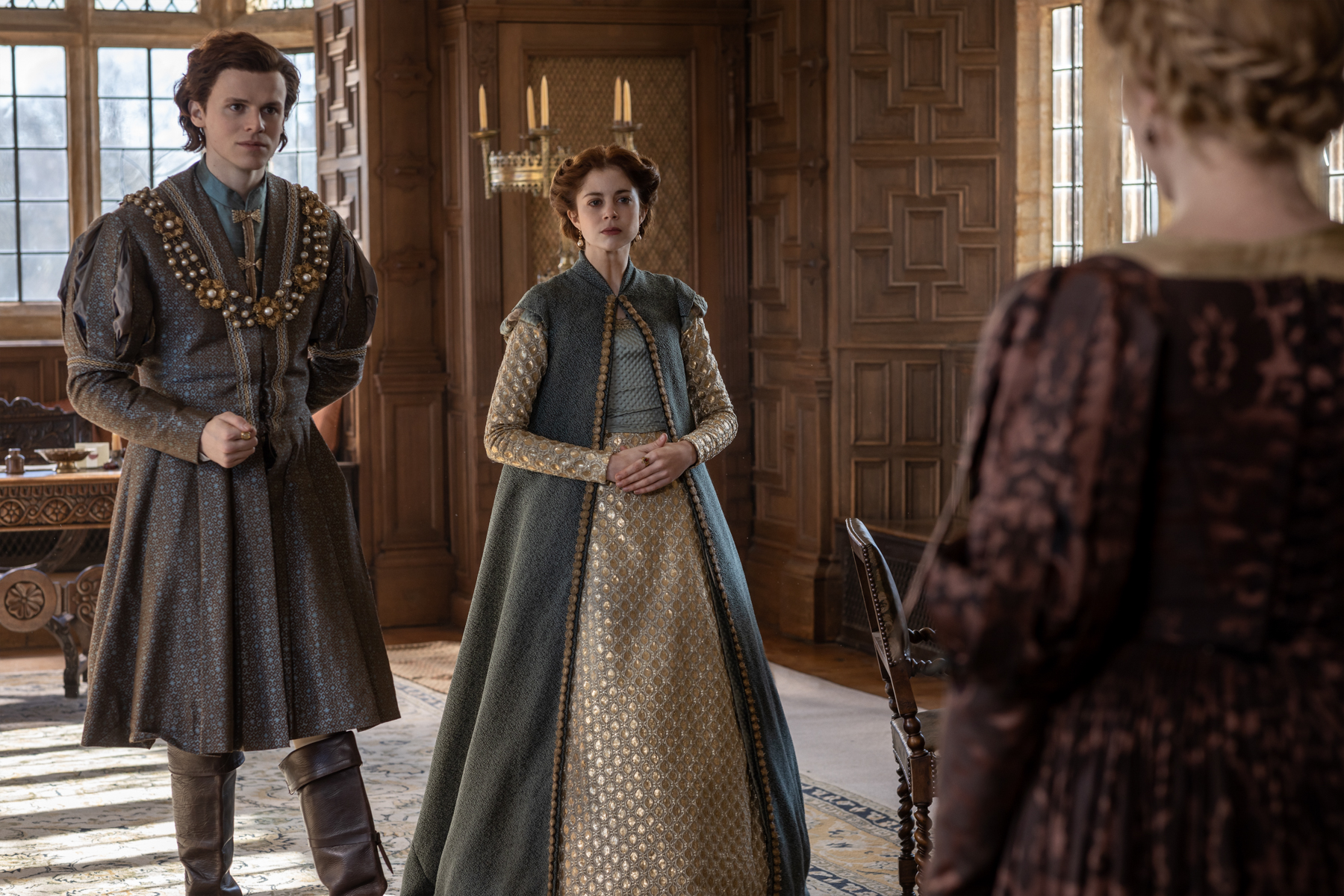
To be fair, The Spanish Princess also does its best to make Henry’s response to Catherine’s repeated losses a multi-layered thing, as well.
Unfortunately, most of those layers involve things like selfishness, petulance, and anger, but the show is clear to position all of them as a response to very real anxiety and grief. (Just from a man who’s never been asked to consider the world from anyone’s perspective other than his own.)
That Henry is a self-centered ruler who will, for his life entire, be incapable of seeing himself in the wrong informs his every action, and explains why he’s so drawn to a man like Wolsey, who spends his time fluffing his ego and blaming Henry’s problems on other people.
It is Wolsey, clearly, who insists that God’s judgment is meant for Catherine, not Henry, as evidenced by the fact that the king manages to get Bessie pregnant within what appears to be weeks of bedding her. (It is…interesting, let’s say, that a man of the cloth is so willing to overlook the adultery angle of all this.)
But it is also the answer that Henry wants to hear, one which excuses his worst excesses of rage and lust and selfishness, and leaves him blameless and without fault.
Would he be looking for these sorts of answers if it were Catherine’s counsel he still most heeded rather than Wolsey’s?
I think Catherine’s complex dissection of her own feelings about Bessie — her dark, hidden hope that her rival might miscarry, her anger that she is always called on to be the magnanimous one as both a wife and a queen, and her attempt to understand Bessie’s position despite her anger toward and dislike of her — holds the answer to that.

Catherine is a complicated woman, but she sees the world beyond herself in ways that Henry is unwilling to do because she recognizes that such self-reflection is genuinely hard work that requires both sacrifice and shame.
Instead, in choosing Wolsey to sit at his right hand, Henry decides to listen to a man who reinforces the worst aspects of his character rather than pushes him toward his better angels.
In that world, Henry’s desires are law, others must do as they are bid, and he is not accountable for anything. Everything that turns out poorly is someone else’s fault, and Henry is blameless.
He can treat women as he chooses — whether they are his royal sisters, his lady wife or the woman he’s tempted to bed and got with child.
His treatment of both Meg and Mary is proof enough of this, and his lies and pettiness toward them leave either little choice but to try to forge their own futures.
If only Catherine herself could do the same.
Stray Thoughts and Observations
- Henry VIII was famously afraid of sickness and germs, and he constantly took his court on progress from London to escape the prospect of disease. But he was not, generally afraid of the “plague”, as we know it, or as it is here presented on The Spanish Princess. Bubonic plague — what modern viewers think of as the Black Death — swept through Europe in the mid-14th century, killing huge numbers of the population. Smaller outbreaks of plague happened at various points through the next century or so, but by Tudor times there were not large public outbreaks on the same scale.
- What Henry Tudor — what all of England, really — feared during this time period was a disease known as “the sweat”. The so-called “sweating sickness” mostly likely came to England with the troops that backed Henry’s father against then-King Richard III, and was a deadly, fast-moving disease that could break out without warning or obvious cause. Modern doctors still don’t entirely understand what caused it today, or why it suddenly stopped appearing, either.
- According to this episode, it appears that Anne Boleyn is now a lady in the queen’s rooms. The show doesn’t tell us when she returned from France, but the dark-haired girl named Anne who sits with Catherine in the wagon to Hampton Court is the daughter of the Earl of Wiltshire, a title that Thomas Boleyn held. (Though, to be fair, Boleyn was not named Earl of Wiltshire until 1529, well after Henry had already started chasing after Anne, so this is a little early, but let’s go with it.)
- Bessie Blount’s son will also be named Henry, and will be called Fitzroy, a sobriquet that literally means “son of the king.” He is the only bastard that Henry ever acknowledges, is named Duke of Richmond and Somerset at the age of six, and dies when he is just seventeen.
What did you think of this episode of The Spanish Princess? Share your thoughts in the comments below!
Critic Rating:
User Rating:
The Spanish Princess airs Sundays at 8/7c on Starz.
 Follow us on Twitter and on
  Instagram!
Want more from Tell-Tale TV? Subscribe to our newsletter here!
Why ‘The Spanish Princess’ Is Exactly the Kind of Period Drama We Need More Of
Lacy Baugher

Lacy is a pop culture enthusiast and television critic who loves period dramas, epic fantasy, space adventures, and the female characters everyone says you're supposed to hate. Ninth Doctor enthusiast, Aziraphale girlie, and cat lady, she's a member of the Television Critics Association and Rotten Tomatoes-approved. Find her at LacyMB on all platforms.