
The Comey Rule Review: Night One (Season 1 Episode 1)
As Mark Giuliano (Brian d’Arcy James) says nearly halfway through the episode, James Comey believes being right will save him. It’s the truest statement of the episode.
On The Comey Rule Season 1 Episode 1, “Night One,” we are taken inside the investigation of the Hillary Clinton e-mails, the rise of Donald Trump, and the growing power Russia holds over American consciousness.

The first night frames the plight of James Comey in a way where it’s asking you to see things through his eyes, to see the events as he does in the moment so that his decisions are given proper context.
The noise of politics hovers just above every minute, every move, and every decision, and the difficulties of a non-political investigation that is being turned political are exponentially greater as the election year takes off.
Whether you agree with Comey or not, it’s a fascinating predicament.
The story that brings us into Comey’s perspective is the one he tells President Obama in the Oval Office, of a home invasion that could have gone wrong in the blink of an eye. It’s likely the defining moment that elevates him toward the path of law enforcement, and it shows his dedication to protecting people.
This is about protecting people and taking out the bad guys.
But through a tunnel vision and not seeing the forest through the trees, he may have done just the opposite.
The Hillary Clinton e-mail server issue has been done to death, and then some, and so I’ll hop over that. The investigation itself, as shown on the episode, is treated with care and intelligence, showing that the work done is proper and correct.
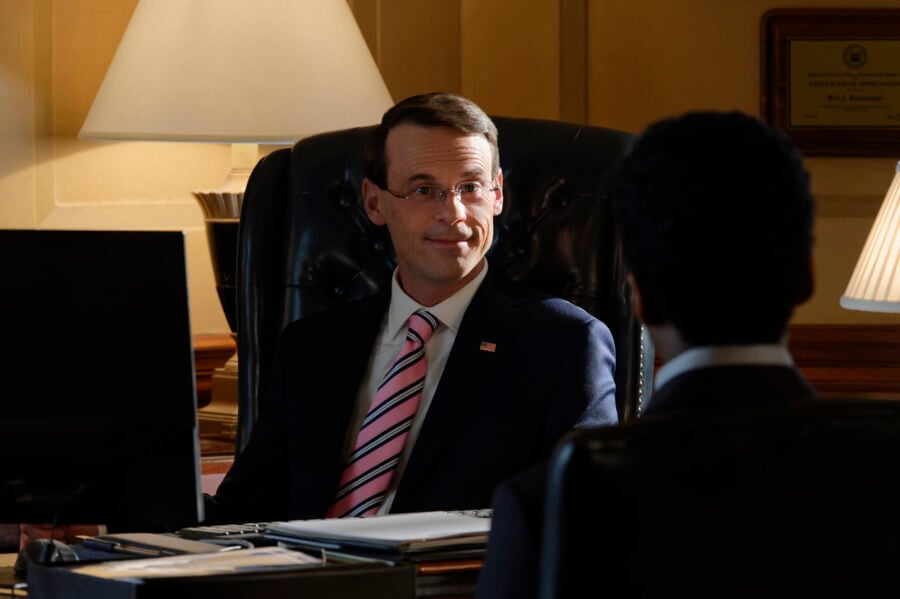
Rod Rosenstein as an occasional narrator is an intriguing way to keep him in the limelight of the story before he becomes a more central figure, as you never can tell if he’s denigrating Comey and his methods, or if he views them as moves of a secret manipulator.
Scoot McNairy plays Rosenstein with a casual aloofness, where his mild manner gives his comments the right amount of air during the hardest decisions Comey must make.
The main issue of the episode is whether Comey really needs to make the “extremely careless” speech, or is this just a cover for the FBI and himself?
The idea of doing the right thing in itself becomes a weapon, as the clinical, almost mathematical way Comey decides to announce the re-opening of the investigation over the Weiner laptop, and the speech he makes to initially close it, are not looked at as due diligence, but as putting his finger on the scale at the worst possible moments.

We see here it’s not that way, but as is everything in politics, perception is everything. Even as Trisha Anderson (Amy Seimetz) speaks to this, almost as the lone voice of reason for the damage this may cause apart from Jim Baker (Steve Zissis), it starts to become clear what’s happening.
The FBI on The Comey Rule views things in the analog, about the data and the protection of its foundations. But where the error comes is in the emotion of it all, the fact that the ramifications and the meaning can be used nefariously. The message isn’t a factor, and it never could be.
The women in James’ life, his wife Patrice and his daughters, keep trying to put that emotional ideal into view, but the mechanical side is too strong for him.
It’s especially painful as they almost plead with him at the re-opening, because they know it’s the execution of Hillary’s campaign and he’s the hangman.
One scene that sticks out more than any other is the fact that the e-mail investigation is made public (through Congress) while Trump’s Russian ties are kept secret.
Trisha voices this to Comey and the team, and it should rightfully be a moment of clarity, that Hillary’s e-mails are given infinite attention while Trump’s campaign plays footsies with the Kremlin.

But it is brushed aside because of the optics, not realizing the larger optics of hiding a possible foreign influence at play. It’s the greatest moment of frustration, in hindsight.
The great irony for the secondary e-mail investigation is that there’s a countdown showing how close things are getting to the election, but really, the election is already underway. Early voting, absentee ballots, and the like are happening, so while the hope to finish in time for the election is at hand, it’s already too late.
The damage is done.
The end of the episode treats Trump’s win as a deflating moment, where darkness has descended upon a land. It’s the poisoning of the well, and as Comey finds both at the polling station and at dinner, he is viewed as the tipping point. Even his wife as he returns home that evening looks at him almost in the same light.
Hell has come, and now that must be part of it.
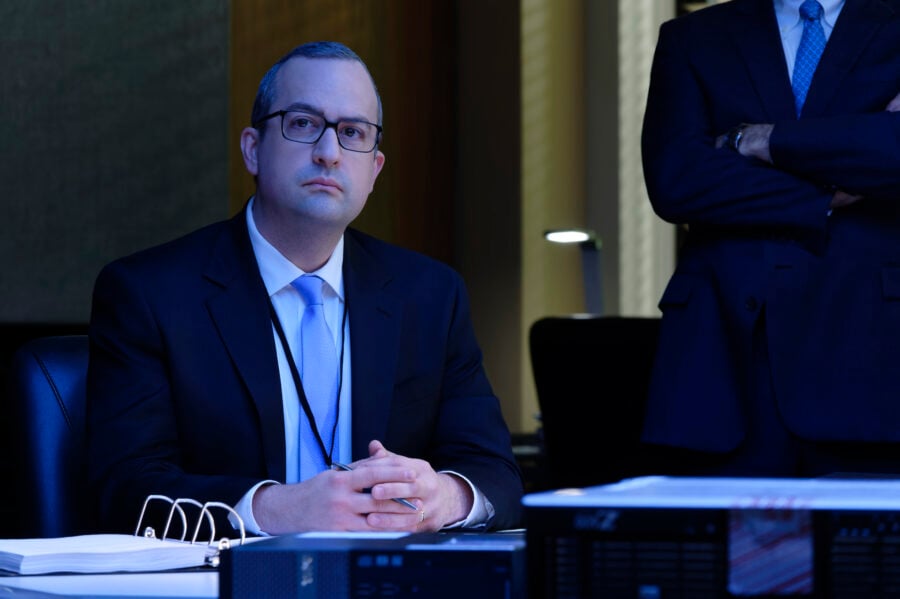
Jeff Daniels makes for a stoic and principled James Comey, but there is this feeling that we don’t entirely know him. Maybe this is him, where the work and the need to do right is his largest traits. At the same time, we don’t see him beyond that work outside of short snippets that help soften him, but don’t prove enough (at least during these initial two hours).
Hopefully the second hour will provide more of this.
Mistakes born out of honesty is a large theme of the first night on The Comey Rule. It’s a sometimes distant look at the men and women who may have shaped the 2016 election, displaying the facts and allowing us to be the judge.
James Comey wants to do the right thing, and it could be chalked up to naivety or hope that people will take his at his word. This will likely be debated for decades to come.
For The Comey Rule, though, it’s a mostly successful reminder that sometimes good intentions don’t produce the best outcomes.
What did you think of this episode of The Comey Rule? Share your thoughts in the comments below!
Critic Rating:
User Rating:
The Comey Rule airs Sunday and Monday at 9/8c on Showtime.
 Follow us on Twitter and on
  Instagram!
Want more from Tell-Tale TV? Subscribe to our newsletter here!
Kevin Lever

Kevin Lever has been following television closely for most of his life, but in starting to cover it, he has grown a further appreciation. He strives to give the blockbusters their due, and give the lesser known shows a spotlight to find more fans.