

For All Mankind Review: Bent Bird (Season 1 Episode 9)
Everyone is questioning who they are, what they are capable of, and what they want to be on For All Mankind Season 1 Episode 9, “Bent Bird,” as tragedy and mishap threaten to throw their lives into chaos.
The episode smartly places characters into their most trying time, or to a limit that requires them to rise to the occasion. In both cases, For All Mankind reinvents its characters by showing how they react to the pressure or tragedy, and where it takes them from there.

Karen finds her redefining as a moment of clarity, where she no longer recognizes the life she’s come to call her own. The loss of Shane has left a large hole in her life, and the questioning of what it’s all about, who she is and what she wants to be is idealist, rather than defeatist, in its approach.
Karen turning to Wayne during her time of need is one of the best surprises of the episode, as they are both linked by their bonding during For All Mankind Season 1 Episode 5, “Into The Abyss,” as all of the great character work done during that episode helps cement their friendship and leaning on each other as a wonderful alternative to the pageantry of looking after Karen at home.
The trip down memory lane helps center them beyond simply being the spouses to astronauts, but as two people who started on a different path and shifted into their current lives. Wayne’s advice, of how he left a sure thing in medical school to be who he truly is, is as perfect a voice for Karen, as Karen finds herself in a life she can’t accept as hers.
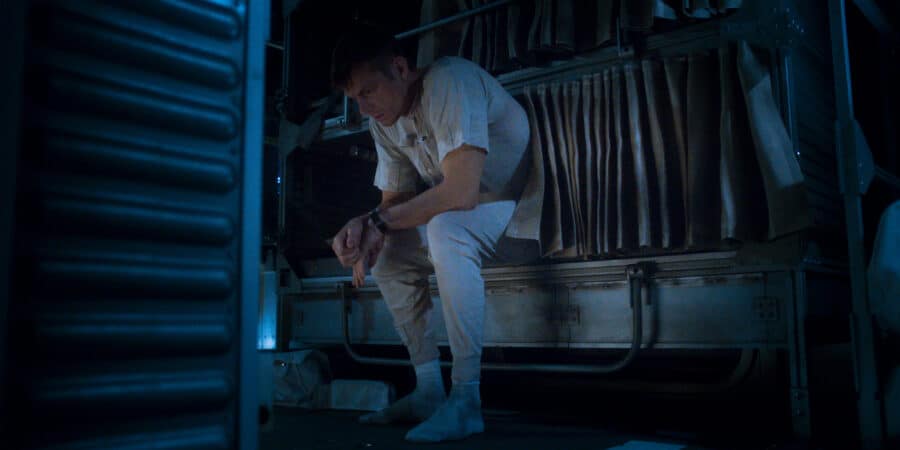
Their conversation is a wonderful moment for the show, as it reveals that an unexpected voice can be the exact thing needed to right the ship, so to speak. Wayne is Karen’s way of waking up from her tragedy, though it’s something she will carry with her every day.
The FBI’s grip on anyone even near the space program finds another victim, with Aleida’s father, Octavio. Getting pictures for his daughter’s wall, and being a good person and protecting her leaves him, in their eyes, as a spy, a hard moment that leaves a burden of injustice to the scene. It’s another moment where hope feels far away, if good people are getting hurt.
Ed’s replacement at Jamestown Base continues to be rattled by accidents and uncertainty.
Ed taking on the Russian cosmonaut and accepting his darker intentions leads to the first casualty on the Moon, done in such an unsporting and bleak manner. Ed has reached a point of going too far. He’s ignoring reams of reports as he pays respects to Shane, so perhaps the head games the Russians pulled on For All Mankind Season 1 Episode 8, “Rupture,” have left him in a less-than-ideal places.
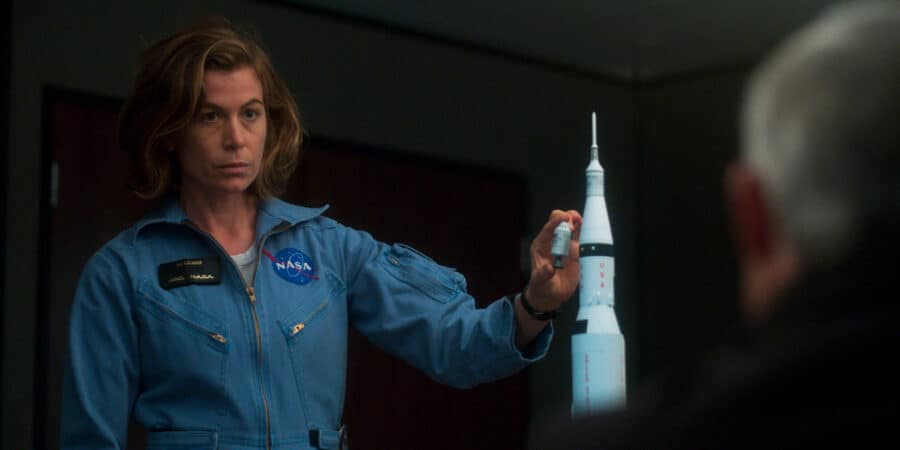
The threat with the rock hammer at the crater lift is more than enough to place animosity between the two astronauts, and with Ed on a short leash with his patience and kindness, it’s a perfect storm of vengeance and distrust. Ed’s mention of messing with the Russian shuttle proves there’s intent to his actions, and that the isolation and tragedy in his heart is making him the darkest version of himself.
The sudden firing of the Apollo rocket and ensuing chaos is one of the most surprising and devastating moments that For All Mankind has gone for, and it’s a gripping, unrelenting moment of clarity. It’s a make or break time where everyone’s duty comes to protecting what is left and not to let the shock take over, which could easily send it all to failure.
The moment places an impossible choice on Margo, and while her choice to abandon Molly in space may come as cold, it’s because Margo thinks in practicality rather than in possibility. Hope is relied on less lately on the show, and so when the rest of the ground crew wish to rely on it, Margo’s initial reaction is to work in certainty over uncertainty and chance.

Tracy and Gordo turn out to be right in their relying on hope, but it comes with personal cost in the process. Molly may be saved, but Apollo 24 may be lost. That Apollo 24 is rocketing off into nothingness is such a dire end to Ellen and Deke (along with their crew member getting burned up), placing hope that something fixes their situation. But by the way ground control is reacting, there may be no hope.
Which is a feeling that For All Mankind Season 1 Episode 9, “Bent Bird,” leaves in us, despite the hopefulness in personal victory for Karen. The show started out with the promise of idealism and striving for something bigger, and on “Bent Bird,” it’s taking that away and placing a more nuanced message that all pursuits of idealism come with bouts of pain and loss along the way.
The somber tone throughout isn’t one of doom and gloom, but of pitfalls and setbacks that cements the damage and pain this line of work will always have. Nothing is ever a guarantee in space exploration, where anything that can go wrong can easily go wrong. But it’s the pursuit, and the striving to continue that pursuit, that makes the possibilities worth the pain.
What did you think of this episode of For All Mankind? Share your thoughts in the comments below!
Critic Rating:
User Rating:
For All Mankind airs Fridays on Apple TV+.
 Follow us on Twitter and on
  Instagram!
Want more from Tell-Tale TV? Subscribe to our newsletter here!
Kevin Lever

Kevin Lever has been following television closely for most of his life, but in starting to cover it, he has grown a further appreciation. He strives to give the blockbusters their due, and give the lesser known shows a spotlight to find more fans.
3 comments
What a great show! One point: The producers are fans of the space program. Yet, as the show sees it, where is there any good reason for having humans in space? The emergencies are thrilling. My heart was pounding during this episode. We see characters at their best and most heroic (particularly Molly, Dani, and Tracy). But what’s the value of the moon base? There’s another technical catastrophe. (The earlier Saturn V explosion is not something I will forget.) And a particularly sinister turn re the Cold War. I’m loving the excitement but I am also wondering will there be any uplifting news about space.
The value of the moon base is the ability to explore our nearest planetary body. The moon with its absence of an atmosphere provides an amazing time capsule and record of events that are lost on Earth by the effect of weather. It provides a training ground for learning about endurance space flight that will
be necessary for long distance missions like a flight to Mars (in our timeline this role has been served by space stations like Mir and currently the ISS). A better understanding of micro gravity on the body and other living things. And most importantly as a fuel stop for further out missions in the solar system, that was the whole part of discovering water on the moon. Access to water allows them to separate out the hydrogen and oxygen to create a fuel source plus provide drinking water.
Apparently the moon doesn’t have phases in this show. A 14 day night has been repealed?
Comments are closed.