
Fosse/Verdon Review: Who’s Got the Pain? (Season 1 Episode 2)
Fosse/Verdon Season 1 Episode 2 “Who’s Got the Pain?” spends more time focusing on Gwen Verdon and specifically the dramatic evolution of her relationship with Bob Fosse. If you thought Michelle Williams was good in the premiere, well, that’s nothing. Here, she is magic.
Even in moments where the script does not rise to the occasion, Williams is nothing short of spectacular and her ability to capture the physical and emotional changes as age and baggage wear on Gwen’s relationship with Bob is impressive.
Though the episode still insists on using the sometimes irritating countdown structure to denote changes in time period, this time, the countdown is centered around the lives of the women in Bob Fosse’s life, using when Gwen won her first Tony and when Joan, Fosse’s first wife, succumbed to diabetes as markers of time.
It’s not my preferred method for seeing a story told but it does, at the very least, help telegraph exactly where in the timeline we are as events unfold over the decades.

On this episode, it’s helpful — and frankly much better narratively — that the show hones in on two key periods in the relationship between Gwen and Bob.
We see them meet as they begin their first project together, Damn Yankees, and we revisit them during the breakdown of their marriage, which immediately followed principal photography for Cabaret.
As the episode volleys back and forth between the two time periods, the contrast is dizzying, as are the similarities at the root of both stories.
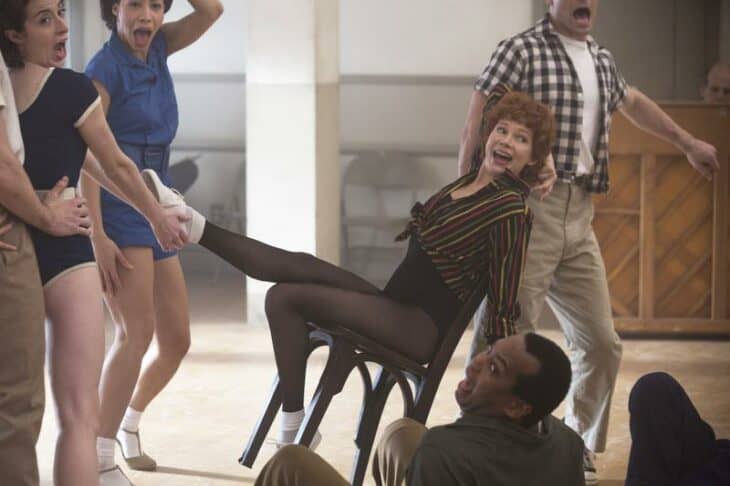
In 1955, when the two first meet, Gwen is a star. Self possessed, playful, and successful, she glows as she bounces around rehearsal studios and charms everyone she meets.
Much has been said about Gwen’s joie de vivre and Williams captures this well. The Gwen of the 1950s had the world at her feet and she knew it.

That’s why the Gwen we meet in the 1970s is so startling; part of this is due to exceptional work by the make up and hair team, but part of it is Williams’ physicality. Instinctually, she understands that this Gwen walks differently in the world.
She is exhausted and she is gravely hurt. Age has slown her down but so has her decaying marriage.
Years ago she made a deal with the Devil when she got involved with Bob, and now, she faces those consequences.
Theatre fans familiar with the plot of Damn Yankees will more immediately see the parallel between the Faustian inspiration of that plot and the Bob/Gwen storyline on this episode, but even the uninitiated will be able to make some of these connections.
While the extent of Gwen and Bob’s partnership is still unknown to much of the general public, even less known is his marriage to Joan McCracken (Susan Misner). As an aside, Misner, playing what could be a thankless character, is great on this episode.
Joan was Bob’s wife when he initially met Gwen, and as Joan explains to Gwen, Bob was married when he first met Joan too.
He consistently has “traded up,” saddling up to a woman with greater star power and influence in order to enhance his own.
The scene where Joan confronts Gwen is the most intriguing one of the episode.
Joan, despite her debilitating sickness, is quick on the uptake and susses out that Gwen and Bob are bedmates as well as coworkers. She forewarns Gwen. She may have caught Bob’s eye now but his attention can wane easily and always comes with an ulterior motive.
Did [Bob] tell you I got him his first job as a choreographer? He’d gone to Hollywood thinking he was going to be the next Fred Astaire, can you imagine? God knows he had the talent, but he just didn’t have the…whatever it is that makes you you, Gwen. He never thanked me for giving him a career. He never wanted to be a choreographer. All he ever wanted to be was a star. I guess I couldn’t make him one. Well, maybe you’ll do better.
While Williams conveys Gwen’s discomfort in the moment, ultimately, we see history repeat itself. Years later, the usurper has been usurped as Bob confesses he has fallen in love with the translator on the set of Cabaret. There is always another woman.
The scene is also intercut with excerpts of a performance of “Who’s Got the Pain?” a musical dance number about pain masked by whimsy, smiles, and a thrust of the hips.
While the musical number could be a metaphor for essentially the crux of all musical comedy — an exercise in making people laugh while someone is in pain — its positioning in the episode alongside the Joan/Gwen scene is important.
There’s an undercurrent of pain all throughout the musical number; we can’t be fooled by the smiles. Behind the scenes, Bob and Gwen are deeply hurting Joan, and obviously as viewers, we know the pain down the road in Gwen and Bob’s marriage.
The construction of the episode cannot be faulted. The dueling storylines are used to great effect, helping tie the past and present (if we want to consider the 1970s the present).
With that said, Fosse/Verdon could push things further. The episode, while well done, still feels heavily expository in nature when it could be providing commentary.
For example, if Gwen was cautioned by Bob’s first wife about ultimately being replaced or being a means to his success, why did she still go after Bob?

We see a charming first glimpse as they work through a choreographic sequence, but we’re left wanting. What about their understanding of each other was so undeniable?
What, for that matter, makes each of them tick, and how have their childhoods informed their approaches to life and to each other? The show hints at them both having some troubled childhoods but backs away from exploring this more fully.
As beautiful as these musical recreations are and as well as Sam Rockwell and Michelle Williams portray a couple in various stages of their relationship, the psychology behind Gwen and Bob’s choices is more elusive.
We know they were two talented, damaged people who were equally drawn to each other and to the spotlight.
We know their marriage detonated and yet their relationship remained. But why? Fosse/Verdon doesn’t seem ready to start posing theories on any of these, but it would be a lot more interesting if it did.
I like the momentum Fosse/Verdon is creating — this episode is stronger than the previous one — and the editing and cinematography is top notch.
However, because I know it’s already good, I’m eager for it to finally be great. Erp!
What did you think of this episode of Fosse/Verdon? Share your thoughts in the comments below!
Critic Rating:
User Rating:
Fosse/Verdon airs Tuesdays at 10/9c on FX.

Want more from Tell-Tale TV? Subscribe to our newsletter here!
Cristina Iskander

Cristina is a Broadway enthusiast, book lover, and pop-culture fanatic living in New York City. She once won a Fantasy Bachelor contest (yes, like Fantasy Football, but for The Bachelor), and can banter about old school WB (Pacey + Joey FTW) just as well as Stranger Things and Pen15. She's still upset Benson and Stabler never got together and is worried Rollins and Carisi are headed down the same road, wants justice for Shangela, and hopes to one day walk-and-talk down a hallway with Aaron Sorkin.