
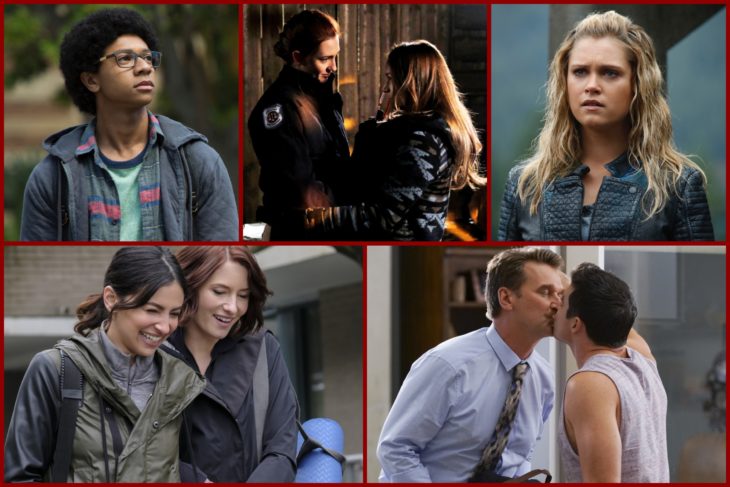
Tell-Tale TV Panel: LGBT+ Representation on Television
June is globally recognized as LGBT Pride Month, so we wanted to spend some talking about our favorite shows and characters that have made a difference one and off-screen.
Check out what our panelists had to say when it comes to our favorite LGBT characters and how representation plays a big part in our every day lives.
Our panelists are:
- James A. Windley; Staff Writer at Tell-Tale TV
- Lissete Lanuza Sáenz; Associate Editor at Tell-Tale TV
- Candice Horde; Staff Writer at Tell-Tale TV
- Lyra Hale; Senior Writer at Tell-Tale TV
- Samantha Coley; Senior Writer at Tell-Tale TV
- Brittany Rae; Staff Writer at Tell-Tale TV
- Hillary Esquina; Staff Writer at Tell-Tale TV
Who is your favorite LGBT couple and why?
James: I’m going to nominate WhiJarryl (White Josh & Darryl) from Crazy Ex-Girlfriend. This relationship is one of the few on television (if not the only) that shows a relationship between a proudly bisexual man—who refuses to let his bisexuality be erased—dating someone much younger than he is.

May-December romances with LGBTQ couples is anathema to television and media, and not only does Crazy Ex treat this relationship as something other than the stereotypical sugar daddy-sugar baby trope that often comes with the territory, it presents this relationship as the most stable in the series, including the heterosexual ones. (Runner-up is Lionel and Silvio from Dear White People, but that’s entirely emotional bias, not logic.)
Lizzie: Though I will agree that White Josh and Darryl are perfect and their story is probably the one that makes me the most emotional, I have to go with Wayhaught (Waverly and Nicole) from Wynnona Earp. There’s just something about the way the show has treated the relationship as something normal, something beautiful, even something to cherish, and allowed them to go through the progression that straight couples would usually get without making a big deal about the fact that these are two women that just speaks to me.
Candice: Lizzie and James, I agree with both of you. I think it’s important that LGBTQ relationships break dangerous stereotypes and not only represent stability, but highlight the importance of mutual respect and love. That is why my favorite couple would have to be Lito and Hernando from Sense8. Throughout the entire series, they have supported one another and helped each other grow.
Moreover, we got a wonderful moment in both seasons (Lito when she was in the art gallery talking to Nomi and Hernando when he was in class and his student tried to embarrass him) that explained why their love was so beautiful and worth aspiring toward.
Lyra: I’m with Lizzie here. It’s Wayhaught from Wynnona Earp. for me. (Close second is Freelin from The Originals.) Wynnona Earp. has just started on its second season, presenting new challenges for Waverly and Nicole. The writers are fleshing them and continuing to show us that even LGBT relationships are complicated, beautiful, loving, and require a whole lot of work to keep them going.

Samantha: I’ve got to echo Lizzie and Lyra here, my favorite couple right now is Wayhaught from Wynnona Earp as well! I think there’s just something so natural and realistic about their relationship that really speaks to a lot of people. I also really love Clexa from The 100 as well as Root/Shaw from Person of Interest, and obviously Sanvers from Supergirl. These relationships were some of the first LGBTQ relationships I saw that I really related to, and they really helped me accept and embrace who I am. 
Brittany: Root and Shaw from Person of Interest! They were my first experience with having an LGBTQ couple I loved actually happen — and not only did it happen, but had been planned from the very beginning. Their love story evolved over 3 seasons and was handled so delicately and respectfully (ending aside).

Seeing two neurodivergent people navigate a relationship in the middle of the AI revolution without ever asking the other to change in any way was an incredibly special thing. I also have a ton of love for Clarke and Lexa from The 100, Nomi and Amanita from Sense8, and Lito and Hernando from Sense8.
Hillary: I love how much love Wayhaught is getting! They are also my favorite couple right now. Lizzie makes a great point about there is just something how that show treats this relationship and I think that has everything to do with Emily Andras, Katherine Barrell, and Dominique Provost-Chalkley being amazing.
But man, there have been some great LGBT couples that paved the way including Callie & Arizona from Grey’s Anatomy, Spencer & Ashley from South of Nowhere, Will & Vince from Will & Grace, Mitch & Cam from Modern Family, and the one that showed me a future was possible, Bette & Tina from The L Word.
Who is your favorite LGBT character and why?
James: Lionel Higgins from Dear White People. When you see a black gay man on television, he’s either armored closet gay (a la Omar Little) or camp gay (I’m looking at you, Titus). No shade to either; it is absolutely acceptable to be on either end of that spectrum.
But there are folks whose only exposure to diversity is through television and media who have never known about the considerable subset of black gay men that, like Andre Braugher’s character in Brooklyn Nine Nine, are both comfortable in their sexuality but don’t want to be defined by it.
Lizzie: Elena Alvarez, One Day at A Time. Funny how we’re all picking characters we can relate to, one way or another. Elena is smart, and yet she’s a teenager, she’s going through things, she’s discovering who she is and who she loves and who she wants to be, and the best part of her coming out story is that it develops slowly, that it’s portrayed in a realistic way and that it’s framed in a way as to highlight the importance of family, and not just blood family, but the people who love you for who you truly are.

Candice: Tiana Brown from Empire. I agree James. I absolutely love seeing LGBTQ characters from the black community who are comfortable in their skin. I love Tiana so much, because we got to see her get to that point. Initially, she tried to hide that part of herself to maintain her public image. However, once everything came out, she was far from apologetic.
She loved her girlfriend and she wasn’t willing to hide that part of herself anymore. What makes it even more great is now she’s openly bisexual and so comfortable in her sexuality, she’s willing to seduce a woman in front of a room full of people with all eyes watching, because she feels like it. I LOVE her sexual liberation.
Lyra: This is where Freelin from The Originals comes in for me. Keelin and Freya are just embarking on a relationship together and I’m loving the former so much! This is a whole new experience for Freya and Keelin is there no matter what. She is a supportive and independent character who isn’t just sitting there while her woman goes off to fight The Hollow. She’s working, thriving, and has Freya’s back despite the rocky start they had or what challenges they might face in the crazy that is New Orleans.

Samantha: I actually have a few, because of course I do. Firstly, I treasure Clarke Griffin from The 100. Clarke is the lead of the show, an incredibly complex anti-hero, and she also happens to be bisexual. I love that The 100 writers have explicitly stated her sexuality and I love that it’s just another part of who Clarke is, rather than a plot point. I love seeing someone like me portrayed as the hero on one of my favorite shows.
I am so grateful for Alex Danvers from Supergirl. Alex’s beautiful and realistic coming out story in this past season was a revelation. Alex gives so many viewers (including me) strength, hope, and courage.
And I can’t name favorite LGBTQ characters without mentioning Callie Torres from Grey’s Anatomy. Callie’s realization that she also likes women is one of my favorite television arcs. Additionally, I deeply love and relate to the way Callie stands up to her very religious father. She’s also the longest running bisexual character on television!

Brittany: How do I pick just one? Clarke Griffin is incredibly special to me, as she helped me realize and embrace that I too am bisexual. River Song from Doctor Who is also a huge formative character for me because of her confidence and casual approach to her sexuality. The writers have stated that River is unabashedly pansexual (much like Jack Harkness) and I love seeing that represented on TV.
Hillary: I agree Sam, Callie’s story line and arc resonated with a lot of people for many reasons. I think her journey was a positive portrayal that helped engage a large fan base to understand that the LGBTQ community is made up of lots of different stories and unique identities.

Cosima from Orphan Black is another favorite of mine. She is fiercely loyal to her family and her sexuality didn’t define her, which was great to see. I also have to mention Nicole from Wynonna Earp because she is a strong female character who has made an impact in my life as I use her story line to help the teens I mentor.

Who has had the best coming out story line?
James: Supergirl’s Alex Danvers, of course. As Kara points out, Alex had never been so happy as she was when she met Maggie, and watching her slowly figure out why was one of the most satisfying journeys I’ve ever been on. She went from this hard-ass older sister with a semi-permanent frown to an adorkable, goofy big sister after discovering her real self, and there is absolutely nothing more beautiful on this Earth.

Lizzie: I’m going to agree with James, but only because I already talked about Elena earlier. The thing about Alex, though, is that the contrast between S1 Alex and S2 Alex is so marked, and you can see, very clearly, in S2, that it wasn’t really because Alex was hiding who she was as much as it is that she hadn’t discovered it yet.
And we got to see her journey, we got to see her realize, through her love for Maggie, that she didn’t have to be just Alex the agent or Alex the sister, that she could be Alex the woman, and be happy, and that was wonderful.
Candice: I’m also in agreement with both of you… again. Haha. Alex’s story was so well executed. As you said Lizzie, you truly got to see her realize a part of herself she had never known existed before.
We also got to see Maggie yank that side out of her, and see her be a shade of happy we haven’t gotten to see in her until she realized who she was. I adored her storyline on Supergirl this season. Her and Maggie’s arcs were one of the reasons I made sure I never missed an episode.
Lyra: I want to say Sanvers so bad because it was a richly layered story that connected with so many people. But alas I have to pick Darryl Whitefeather from Crazy Ex-Girlfriend. In the musical production of my life I hope to have a coming out as bisexual moment that turns into a fabulous song like Darryl’s. I require whoever plays me to be wearing the same white suit and that at least one of the backup singers has a keytar. Non-negotiable.
But on a more serious note, bisexual representation is pretty scarce on TV. His coming out story was needed and appreciated by bisexual people like me. Hopefully TV networks will be a little more open to characters like him in whatever programs they decide to pick up next.
Samantha: These have both already been said, but both Alex Danvers’ from Supergirl and Elena Alvarez’s from One Day at a Time are very important to me. Both coming out stories are wonderfully realistic and the characters were given season long arcs regarding this journey that often takes years in real time.

Alex’s story and her bravery gave me the courage to come out to my own family. And seeing Elena’s family’s various reactions,especially seeing her mother overcome her conflicting feelings was really encouraging. Both of these stories give me a lot of hope for our future!
Brittany: I have to agree with the Elena choice! It’s so important for young girls to see themselves on TV, and to know that coming out at any age is okay. It’s also really amazing to see that even though the experience isn’t always smooth sailing (for both yourself or your family), things can absolutely work out in the end. Elena and her family care more about each other than what people think, which is a beautiful message that I think is key in the world we live in.
Hillary: We have seen a few coming out stories that didn’t go so well like Serena Southerlyn on Law & Order, and others that have been spot on like Alex Danvers and Elena Alvarez as mentioned above. But I feel that Spencer from South of Nowhere and Bianca from All My Children also had some of the first coming out stories that had a major impact on the community.
Both Spencer and Bianca’s coming out stories also showed different reactions whereas Alex was predominantly positive and Elena showcased a split family over her coming out. I think knowing there is a balance helps the community in a huge way because everyone’s coming story is different.
Why is representation in television important to you?
James: As I referenced earlier, there are quite a few people in rural areas and metropolitan areas alike whose only exposure to any type of diversity is through what they consume from media. The more exposure you get, the more knowledge you have. The more knowledge, the more acceptance.
Lizzie: James makes a great point, and I just want to add that there’s something incredibly powerful about seeing yourself on-screen, about thinking, boy, what I am, who I am, is normal — see, there’s someone like me on TV and it’s okay, it’s beautiful and I should celebrate it like they celebrate it.
Candice: Both of you make great arguments. It’s not only important to spread understanding the thereby increase acceptance, but to also give LGBTQ people they can identify with on screen. Representation is so, so important, because it makes people feel more comfortable with themselves. It opens up their narrowed perspectives. It confirms in many people that they are wonderful, just the way they are. These are great reasons why representation is important for the people.

In a smaller vein, another reason representation is important is because it enriches a story. Diversity gives different perspectives and adds experiences to a narrative. It keeps stories from becoming a linear echo chamber of the same situations, and resembles the complexities of the real world.
Lyra: Representation on television is important because we see ourselves reflected in the media we consume. Even more so, we understand what challenges we might face in the real world and what other’s think of us, a scary concept in itself. There is a positive in all of this. Once we see all of that we can work on breaking all those barriers down, erasing preconceived notions about us, and making it better for the generation that comes after.
Samantha: I second everything that’s already been said. LGBTQ people are everywhere in the world. They’re your daughter, your neighbor, your co-worker, your doctor, your mailman, and on and on. Seeing LGBTQ people on television should matter to everyone; LGBTQ people need to see themselves reflected on screen in as many varied ways as they exist in the real world. And like James said, many people need to see more positive LGBTQ representation on television so that they can understand and accept the people around them in reality.
Brittany: I think it makes us brave. The more we normalize seeing LGBTQ characters on TV, the more society will learn to accept that we have always been here and always will be. It feels empowering to see yourself represented in any pop culture sphere and know that someone somewhere is in your corner. Drawing strength from fictional characters isn’t new, but it is especially impactful for underrepresented communities.
Hillary: Man, these reflections are spot on. You all perfectly sum up why representation matters. I will only add that watching television is part of our life experience, and it also serves proxy (so to speak), which gives us the audience experience that help shape our views, give us strength, and diversify the stories to reflect those who watch the shows.
Hillary Esquina

Hillary is television fanatic and spends most of her free time talking about all things television and pop culture, even if it’s just with baby padawan (her son) and her wife. Her current day job is working within the nonprofit sector, and she is pretty much in love with any show that has strong female characters. Never one to be boxed into any sort of genre, her show preferences range from Wynonna Earp and Dark Matter to One Day At a Time and Modern Family.