
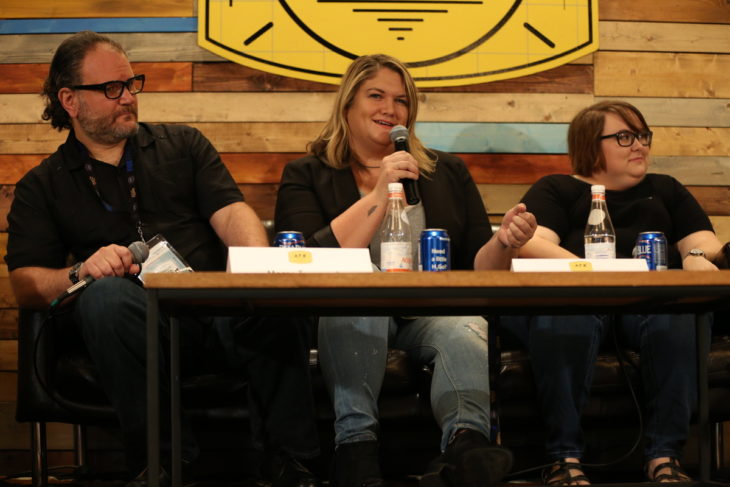
5 Important Things We Learned from the ATX Television Festival’s ‘Bury Your Tropes’ Panel
This year’s ATX Television Festival featured panels on a multitude of subjects, ranging from conversations about stunts on TV to keeping the romance alive on our favorite shows.
One panel that we attended, “Bury Your Tropes: Presented by GLAAD,” focused on the “Bury Your Gays” trope that has existed for some time, but became prominent earlier this year as 4 major lesbian and bi-sexual characters were killed on their television shows in just 30 days, including Lexa, a lesbian character on The 100.
Many fans of The 100 were outraged by Lexa’s death not only due to her sexuality, but because she was involved in a love story with the show’s bi-sexual main character, Clarke, who had consummated her romance with Lexa earlier in the same episode in which Lexa was killed.
As fans struggled to find a way to voice their feelings about the impact that Lexa’s death had on them personally, a petition directed at television writers and showrunners began circling called ‘”The Lexa Pledge.” Details of the pledge can be read here on the official website.
The pledge was created by Noelle Carbone (writer and executive producer for Saving Hope), Sonia Hosko (producer for Saving Hope), writer and director Michelle Mama, and Gina Tass, Leskru fundraiser creator.
Along with the pledge, shocking statistics about the number of LGBT deaths vs. happy endings on television came to the forefront on social media and in news stories, reaching fans, critics, actors, television writers, and showrunners. The number of LGBT deaths on television continues to grow.
Panelists Javier Grillo-Marxuach, Megan Townsend, Krista Vernoff, Carter Covington, and Carina MacKenzie had an uplifting conversation during the panel that focused on much of the progress that has been made for LGBT characters on television, and they also discussed some of the harsh realities surrounding those same characters.
Here are 5 of the most important things we learned from the ‘Bury Your Tropes’ panel:

1. The Lexa Pledge Made an Impact
Every panelist agreed that “The Lexa Pledge” brought to light the serious problem surrounding the treatment of LGBT characters on television, especially in this past year. Faking It creator Carter Covington said, “Growing up gay, of course I had seen, in the ’80s, portrayals of gay people that were less than positive. But I didn’t realize that bi-sexual and lesbian women were being killed off to such extent, so it definitely raised my awareness of the issue and the trope.”
Also speaking about “The Lexa Pledge” was story editor and writer for The Originals, Carina MacKenzie, who said, “Until ‘The Lexa Pledge,’ I hadn’t actually looked at any [of] the statistics.” She continued to say, “When you look at the broader trend, there’s no way to deny the trend, and there’s no way to deny the problem, and it really surprised me. I was shocked by those numbers.”
2. Many Television Writers Could Not Sign ‘The Lexa Pledge’
As television writers, it can be challenging to agree to make a promise that they may not be able to keep. Javier Grillo-Marxuach, writer for The 100 and showrunner for the Xena re-boot, explained the situation for a television writer very clearly.
“I don’t own the IP (Intellectual Property) for anything that I work on. I could sign that and go on any show, and then be told, ‘Hey, we’re gonna kill this character,’ and I could fight it tooth and nail. I could walk into someone’s office and throw a hissy fit, and the character could still die. And then in the eyes of the world, I’m a violator of a promise that I made as opposed to somebody who really made an effort to do something significant.”
Krista Vernoff, currently co-executive producer on Shameless, initially wanted to sign the pledge…until she read it. “I woke up, and there were like, a hundred ‘will you sign this.’ And I saw it and I thought, ‘Well, of course I’ll sign it. It’s an LGBTQ something, I’ve got to sign it,’ and I opened it, and I read it, and I couldn’t sign it.”
Vernoff went on to explain why she couldn’t sign. “To sign a pledge that says, ‘I will limit my storytelling. I promise I won’t kill an LGBT character,’ is going to limit my ability to persuade the bosses to even let me put in LGBT characters. And representation is everything.” She went on to say, “If we sign a pledge that says, ‘We will limit our storytelling around these characters,’ we’re going to have the opposite of progress.”

3. Carter Covington Wanted to Portray Positive Messages for the LGBT Community on Faking It
Carter Covington, creator of Faking It, described the pressures that he felt from fans to give the series’ main characters, Karma and Amy, a happy ending.
“I knew that for me, if Karma and Amy were happy at the end of the series as people, that’s a happy ending for me. I never really saw like, ‘these two have to be together as a couple and they need to be walking off into the sunset together,’ The pressure I felt was from fans who were very vocal that they wanted these two to be together. And the show leaned very heavily on the will they/won’t they of the two of them, that was kind of the sizzle of the show.”
Covington was met with backlash from the LGBT community regarding the romance between Karma and Amy. “I got accused of queer-baiting. I got accused of trying to bring the LGBT community to a story that’s never going to happen. That was really hurtful…I’m trying to put out, what I think is, the most positive message for our community that I’ve ever seen on TV.”
Covington then went on to talk about the work he did with The Trevor Project, and how those experiences impacted what he wanted to portray for his characters on Faking It.
“I’m doing it from my own experience working on The Trevor Project and listening to LGBT students and youth call in in crisis. They weren’t calling in because the people on their television show weren’t together. They were calling in because their families were kicking them out, and they’re homeless because they’re not being accepted. Or they’re scared that they’re going to get beat up at school, or that they, you know, can’t come to terms with it because of their religious identity. So it was frustrating to me to hear that come back to me from the very community that I was trying to help.”
4. Ratio is Important
The number of LGBT characters on a series makes a big difference in this conversation. If a show has a primarily straight cast with just one gay character, the death of that one gay character will be have a much different storytelling impact than it would on a show where there are multiple gay characters.
MacKenzie broke it down very well. “On a show like The L Word you’re talking about a completely different thing than you are if you’re talking about a show that’s got one gay character, and that’s the one that’s on the chopping block at the end of the season.”
Megan Townsend, GLAAD’s Entertainment Media Strategist, elaborated on the dangers of having only one gay character on a show.
“I think that there should never be one of any kind of character because that automatically cuts off a lot of story opportunities, because if you only have one gay character, who are they gonna date? Who are they gonna talk with about their issues? And then we only have one of something they never get a chance to become a fully fleshed out character because they have to represent the entire community, so they have to be kept to kind of broad strokes to be representative of everyone and not alienate anyone.”
5. LGBT Characters Have Made HUGE Progress on Television, and We Should Celebrate That
Vernoff told a positive story about a pilot she recently wrote that included a transgender main character. Though the pilot was not picked up, the major network who considered it read the script and did not give Vernoff one note about the main character’s sexual identity.
She went on to talk about other successes for the LGBT community on television. “When I started writing TV, I used to sit in my chair, sort of rocking, going, ‘Can we PLEASE not have the gay dude be the murderer, can we PLEASE not have the gay dude be the pedophile?’ and now the conversation for me is more like, ‘What stories are we gonna tell?’ The LGBT characters are so much more fully realized that…it’s okay for Mickey Milkovich to try to kill somebody or beat somebody up because so did Lip, and that’s huge progress.”
That progress was echoed by every panelist in some way. Covington said, “We’ve earned the freedom for LGBT characters to be everything in the spectrum, because no longer do they represent the entire community, and I think THAT’s an amazing progress that we’ve made as a television community and as a society.”
The Hollywood Reporter’s Lesley Goldberg, who moderated the panel, also chimed in on LGBT progress. “What’s interesting to me is that these characters that we’re seeing today…the fact that they’re gay is the least interesting thing about them. And THAT’S progress.”
10 Things We Learned About ‘UnREAL’ at the ATX Television Festival
You can check out all of our coverage of the ATX Television Festival right here. (There is a lot more to come!)
Christine Laskodi

Christine is guilty of watching Hart of Dixie more times than the average human will in their lifetime. She's the host of Long Live the Hart: A Hart of Dixie Podcast (available on Apple Podcasts and Spotify!) as well as co-host on The Shipping Room, a podcast devoted to television's greatest relationships. You can find some of her older television reviews at TV Fanatic and IGN. Christine eagerly anticipates every cheesy holiday movie that networks can throw at her, and current favorite shows include The Good Place, The Resident, Shark Tank, and All Rise.