

Exploring Motherhood Through the Lens of ‘All Her Fault’
While motherhood is undoubtedly a universal experience that several women go through, All Her Fault reminds viewers that every mother’s journey is different. Every mother we meet on the show is feeling something different and handling their kid(s) differently.
As a first-time mom, I’m always looking to see how motherhood is portrayed on TV. We hear so many different things about what moms experience that it has been captivating to see how the media translates that into storylines for various audiences.
However, as a solo mom by choice, I’ve paid extra attention to how TV mothers navigate their journey with the help (or lack of it) from their partner. When people hear I chose to have a child on my own, they wonder how I’m capable of handling everything on my own. But if we look at the moms on All Her Fault, we will notice that those with a partner by their side still do everything alone and struggle with the notion of their partner doing nothing at all.
Working vs. Stay-at-Home Mothers

One of the biggest issues the show explores when it comes to mothers is the reality that those mothers who work full-time jobs are judged for this choice. All Her Fault positions both Marissa and Jenny as working moms who drop their children off at school and then spend the day working.
While this isn’t a wild concept, considering most mothers these days need to work to provide for their families, other parents (including a stay-at-home dad) judge them for it. They judge Jenny for needing to organize a playdate for her son while she works late. They try to guilt her into volunteering for the fundraiser instead of spending so much time working.
Marissa is immediately judged for not having the correct phone number for Jenny or paying attention when her son’s playdate was scheduled. The idea that if she hadn’t been working so much, nothing would have happened to her son, is introduced and discussed by the parents who judge her.
The show introduces characters who perpetuate the idea that, for a woman to be a good mother, she needs to stay at home and dedicate all her time to her children, her partner, and the house. However, this is quickly wiped away by the strong presence of Jenny and Marissa.
Solely by looking at Jenny, one can tell that women are capable of so much more. All Her Fault gives working moms their flowers by showcasing the storyline of a woman who can love her career and her son.
Jenny loves what she does and is really good at it. She goes after a hard client and gets the account even when her phone kept going off and her husband was being helpless. At the same time, she is a present mother who knows what her child wants, needs, and likes. She is the representation of how resilient women can be.
Judging Among Mothers

There is a sad and harsh reality represented on All Her Fault, and that is the fact that women are each other’s biggest enemies. Some women are quick to judge and voice their judgment of other women, particularly moms, without knowing what’s happening behind closed doors.
Sarah is the best representation the show has of this. She judges Jenny every step of the way, and is only a bit more careful about judging Marissa because her kid is missing. However, we can hear the judgment in her voice when Marissa first believes her son is supposed to be with Jenny’s son.
Sarah’s judgment continues throughout the series, always invalidating other moms and their parenting style because they don’t match hers. Even though we don’t see much of her personal life, it is clear she has nothing better going on than looking at what others are doing.
When Jenny comes to pick up Jacob after the second playdate, Sarah doesn’t hesitate to pass judgment. She directly tells her she should be looking at her own marriage rather than helping Marissa in the search for her son.
But the truth is that the friendship that forms between Jenny and Marissa is what saves all mothers and breaks the stereotype. Instead of judging one another, these two women find comfort in each other. They can freely speak about what motherhood has been like for them and the connection they have with their partners.
While the other parents at school build their friendships around the superficiality of judging others, Jenny and Marissa build their friendship on trust and confidence. They prove that when women put society’s expectations aside, teaming up is much better than being enemies. One mom supporting another is what it’s all about.
Motherhood as a Married Woman
When people ever questioned my decision to do parenting solo, I wondered if they had ever turned on their TV and listened to what’s said about fathers. While each dad is a world of its own and has experiences of their own, the universal representation has been that when the parents are together (or even not), it is the mother who does everything.
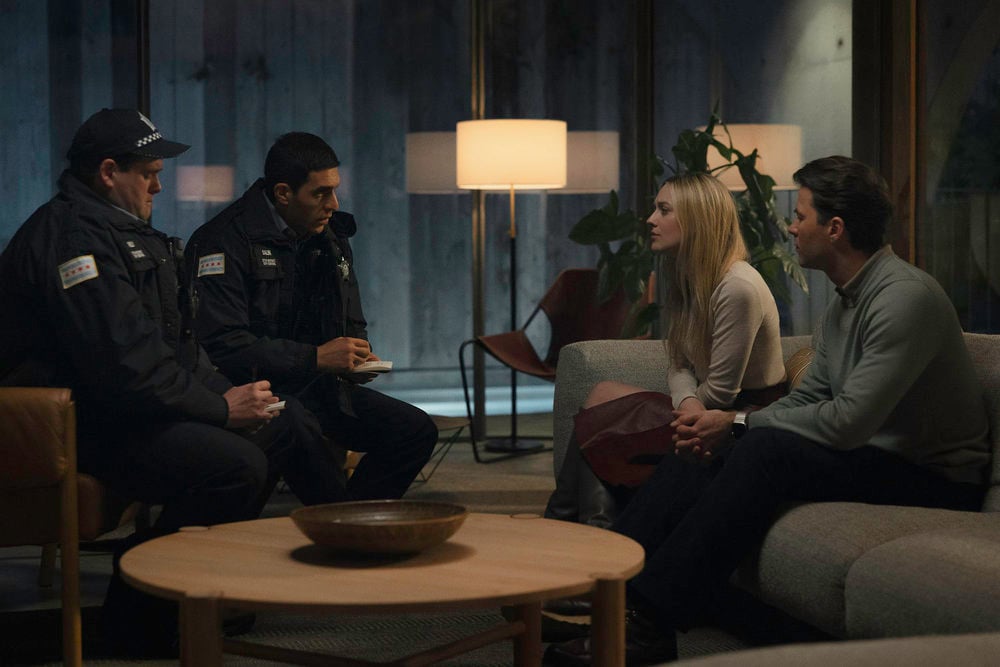
All Her Fault is no different. With the exception of one father who chooses to be a stay-at-home dad and the parenting style of Detective Alcaras, the rest of the dads are terrible. However, what stands out the most is that even married and supposedly relying on their spouses, the women do it all.
Jenny can’t rely on her husband to watch Jacob after he gets home from work because he will make up an excuse and stay in his car, eating and listening to music. Marissa is judged by her own husband for not checking the phone number was correct, and then is expected to check his medication is up-to-date.
These women are pushed to their limits because they need to balance it all. While it’s clear that women are indeed capable of balancing it all, these women in particular are supposed to be able to count on their husbands to be parents. However, the reality isn’t that.
In the end, Jenny divorces her good-for-nothing husband, and Marissa murders her murderer husband. Both women go through absolute chaos and tragedy, but come out the other side stronger than before…and probably better mothers because they are on their own.
At first glance, All Her Fault is about the kidnapping of Milo Irvine, but that couldn’t be further away from the truth. Milo’s kidnapping happens because of who his biological mother was. From that point onward, the motherhood experience becomes the thread that holds the entire show together.
All Her Fault is available to stream on Peacock.
Follow us on X and on Instagram!
Want more from Tell-Tale TV? Subscribe to our newsletter here!
Lara Rosales

By day, Lara Rosales (she/her) is a solo mom by choice and a bilingual writer with a BA in Latin-American Literature known as a Media Relations Expert. By night, she is a TV enjoyer who used to host a podcast (Cats, Milfs & Lesbian Things). You can find her work published on Eulalie Magazine, Geek Girl Authority, W Spotlight, Collider, USA Wire, Mentors Collective, Instelite, Noodle, Dear Movies, Nicki Swift, and Flip Screened.