

The 100 Series Finale Review: The Last War (Season 7 Episode 16)
Just like that, The 100 is over.
The 100 Season 7 Episode 16, “The Last War,” was a strong effort to pull together a chaotic season that has been divorced from the relationships we have always known and loved.
“The Last War” is enjoyable to watch, because it leans back into what made the show great in the first place. It’s the same reason why The 100 Season 7 Episode 8, “Anaconda,” was so compelling. We know that mythos, we are invested in those relationships.
The return of Lexa and Abby was a strong start and the scenes that put our characters in motion were compelling. However, it’s hard to accept that this season was working towards a transcendental ending.
Yes, it does answer one of the show’s essential questions of “can humanity change,” but in doing so also creates a lot of plotholes that could have been prevented if there was at least an inkling of this earlier in the season, and, for the most part, feels like an easy way out.

Failures, Loves, and Teachers
It’s hard to resist the urge to say “I told you so!” when Cadogen finds out it really is a test and not a war. The moment we meet the judge and see the setting that he has selected it feels like a low-key gotcha moment.
You can see how disarmed Cadogen is by seeing his daughter again and how bare he is in that exchange.
It was very hard to connect with Cadogen throughout Season 7, but John Pyper-Ferguson brought a touch of humanity to him at that moment. Until Clarke’s entrance, it’s almost possible to remember that he did love once; but that moment is brief, at best.
Overall, The Judge who takes the form of the subject’s greatest failure, love, or teacher is an interesting concept, and when it came to choosing who would appear to which character, Jason Rothenberg chose well.
Clarke and Lexa’s reunion was another moving and cathartic moment with the judge. Alycia Debnam-Carey delivered a terrific performance that was both Lexa-like and just alien enough to remind us that this being wasn’t her.

Similarly, Paige Turco’s return and her appearance to Raven was both nostalgic and perfectly constructed. While Clarke felt guilty about floating Simone in the Season 6 finale, Raven was the one who had a lot of contact with Abby and who collaborated with her the most.
There were times when their relationship was far from perfect, but seeing these two actors together again is a chef’s kiss.
It’s even more appropriate when you consider that the Judge sees the battle halted while she’s in Abby’s form. Abby, if you remember, said back in Season 2, “Maybe there are no good guys.”
The Test and Its Subjects
The fact that one person is supposed to represent an entire race is problematic, at best, and really sadistic at worse. Clarke is right when she calls them out on exterminating entire species because they don’t fit their preconceived ideal of what they should be.
The people the Judge encountered are all very different and all provided unique views. None of whom represented all of humanity.
The Judge mentions that Becca refused the test, and she was the creator of the technology that caused the first nuclear apocalypse. Her refusal showed some wisdom, and although we didn’t get to see her story play out, it did buy humanity a few centuries.

Cadogen actively pursues enlightenment and transcendence. This season doesn’t do a good job of showing us why he was so drawn to that, but the judge mentions that collective well-being was something Cadogen got right.
Clarke is probably the weakest of the subjects because her values were myopic. She protects Madi above all else at the moment, and her demeanor with the judge is defensive. That posture of protecting and defending is the one that Clarke tends to inhabit the most.
Where the test storyline goes off course a bit, is when Raven gets involved.
The way Clarke looks at Raven and admits her failure and then says “it should have been you,” is heartbreaking, but also confusing. Raven is a strong character with a lot of morals and would have made a great test subject, but I’m lost as to when Clarke came to the conclusion.
When Raven does go in and ultimately saves humanity from extinction–way to go Raven!–she doesn’t defend but instead reasons with the Judge.
It isn’t until Raven goes in front of the Judge that the Judge knows what’s happening in the garden. This alone brings up questions about the limits of the judge’s knowledge and power, but the fact that the Judge witnesses Octavia’s speech and sees an army put down arms just shows the fallacy of judging humanity based on one person.
It also highlights how important other perspectives and experiences are in general. Clarke had no idea what was happening with Wonkru, but the fact that Raven told Octavia and gave her time to act shows that people are being when working as units.
While we don’t see the Judge’s species, we can only hope that the way humanity’s test went down gives them a new perspective.
What the Hell Are We Doing Here?
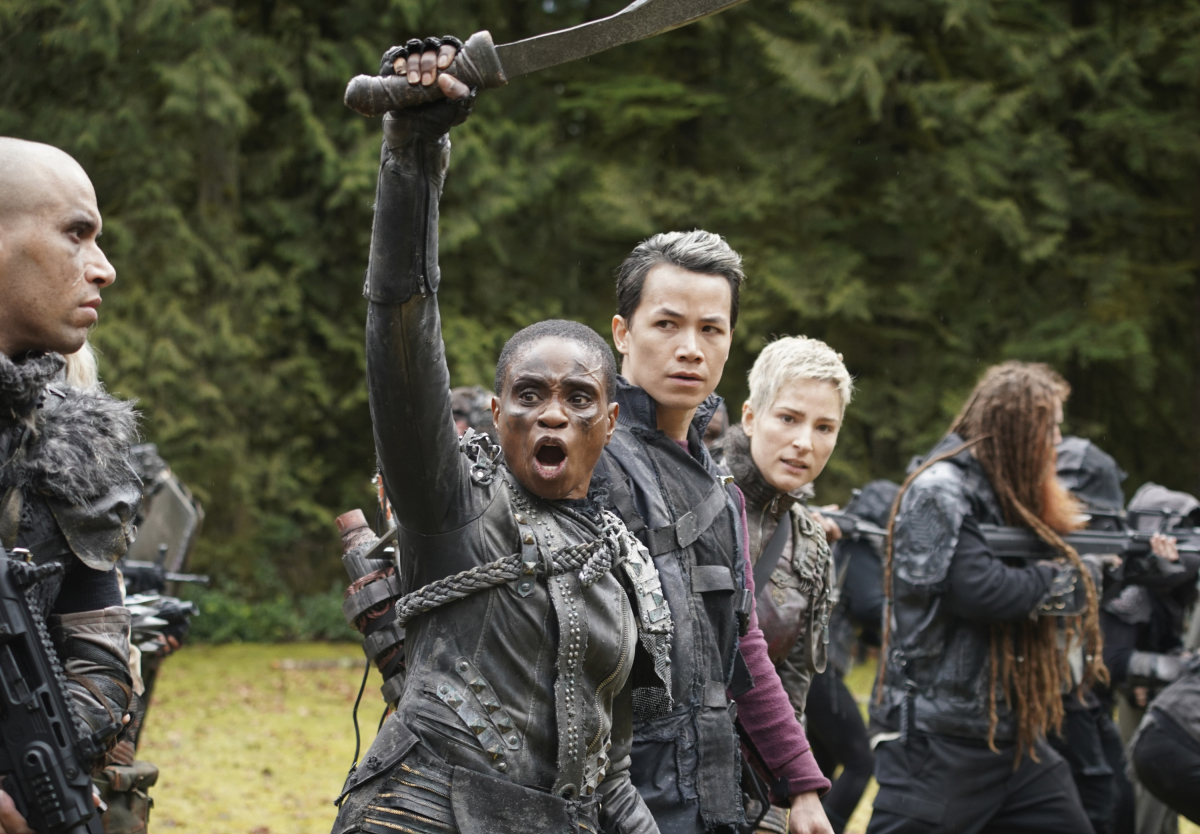
One of the highlights from “The Last War” is Octavia’s speech on the battleground, and there was no better character to give it.
Marie Avgeropoulos delivers an exceptional performance in this scene and it feels only fitting that the character who has waged war be the one to stop it and to help save the human race.
Octavia has been fighting on so many fronts since she was a child, and she understands what war means. She’s seen the people she loves get killed, created a violent environment in the bunker, and held onto power with an iron grip.
OCTAVIA: I’ve been to war, and let me tell you. The only way to win is not to fight.
It was only on Penance with Diyoza and Hope that she got to experience a quieter life and see what it meant to not fight anymore. Not only did Octavia find peace on Penance, but she continued to try to express that violence wasn’t the answer every chance she got.
Watching her slowly reach all the soldiers poised with their weapons is moving and a fitting end for Octavia.
The fact that she then runs back to the forest for her friends who are bleeding out and on the brink of death just in time to see them transcend is glorious.
What Makes Transcendence Desirable?
This is one of the biggest failings of the season. Why I don’t doubt that existing on a higher plane has its benefits (otherwise it would not have been a part of some other sci-fi series) The 100 didn’t make a case for why humanity wanted to transcend. More accurately why Cadogen wanted to transcend.
As much as transcendence allows most of the surviving characters to have some sort of peace at the end of the series it definitely feels more like they’re trying to survive extinction.
The survival instinct has driven much of the series, and the resulting test while in pursuit of Cadogen definitely fits the bill of a final war.

Given that the Judge seems to be able to read minds though, I can’t imagine that there isn’t something to the test that was missing. It feels like fear over extinction wouldn’t be a valid enough reason to grant enlightenment, and the more time that elapses with this finale, the more that question irks me.
On one hand, transcendence was the best ending for characters like Madi and Emori who died just short of the final episode. Clarke’s words to Madi as she resists transcending are heartbreaking:
CLARKE: It’s okay. I know you don’t want to leave me, but you have to go now. This gives you a chance to live. Let go, Madi. Just let go. I’ll be okay.
For the most part, though, it’s hard to believe that everyone would get on board with this idea. Especially given that those who had been in Bardo previously weren’t enthused by Cadogen’s teachings.
While it’s certainly good that this series ends with transcendence and not an extinction-level event, the adaption of belief is a little too sudden.
Wanheda Walks the Planets Alone
Clarke is Wanheda to the very end of this episode, and the fact that death is what disqualifies her from transcendence is a fitting end for her character.
Clarke has suffered a lot and she’s made mistakes, but like I said above; she’s the worst subject that the Judge spoke with. It seems far to ascend everyone else but Clarke, but then introduce the idea that those who have transcended can come back.
CLARKE: Transcendence is a choice? You can choose to come back.
THE JUDGE: Of course, though until now, no one ever had.
Raven in particular recognizes what Clarke has sacrificed for them, and the fact that they wouldn’t want her to be alone says a lot about their bond. Watching them all on that beach, building a shelter is as happy of an ending The 100 could give us.
Adding in the condition that they have, in turn, sacrificed the chance to build families and transcend themselves when they die and the gesture has a lot more weight.
THE JUDGE: There won’t be offspring, and they won’t join us when they die. None of them seem to care.
At the same time, Clarke continues to be Wanheda. Once her friends die, they are gone, and what happens when only one is left?
They are truly the last of humanity, but there is no one left to fight.
Stray Thoughts:
- Nikki and the rest of the Elygius prisoners banning together to save the rest of the people on Earth brought everything full circle. Seeing Nikki and Raven work together is the icing on the cake.
- Lindsay Morgan did not get nearly enough screen time this season, and while “The Last War” gave her some great moments, it didn’t give us enough.
- So the Azgeda symbols on the floor of the bunker will be addressed in The 100: Anaconda, right? Cos that’s a giant plothole you can’t leave hanging.
- Is anyone else bothered by the fact that Picasso is the only dog left in the universe? Or that his existence means that the species called “man’s best friend” isn’t able to transcend? Filing this under my list of reasons why humanity doesn’t deserve dogs.
- The way that Indra says “for my mother” before killing Sheidheda is ideal. While it somewhat negated Raven’s whole thing with the Judge, Indra needed to deliver that final killing blow.
- I just remembered who The Judge reminds me of! Thor and the Azguard on Stargate: SG-1. That show even had its own idea of transcendence where people could come back.
What did you think of the series finale of The 100? Share your thoughts in the comments below!
Critic Rating:
User Rating:
The 100 Seasons 1 through 6 are currently available on Netflix.
 Follow us on Twitter and on
  Instagram!
Want more from Tell-Tale TV? Subscribe to our newsletter here!
Lauren Busser

Lauren Busser is an Associate Editor at Tell-Tale TV. She is a writer of fiction and nonfiction whose work has appeared in Bitch Media, Popshot Quarterly, Brain Mill Press Voices, and The Hartford Courant.