
5 Things We Learned about ‘Good Trouble’ Season 2 at the ATX Television Festival
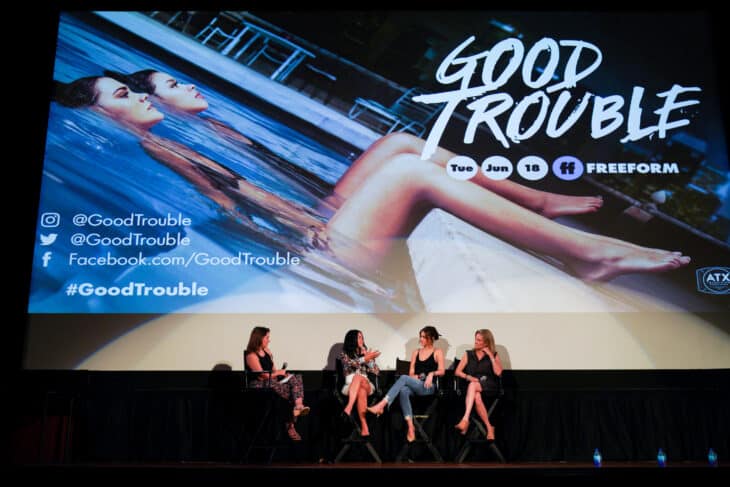
While at the ATX Television Festival, we had the chance to attend the Good Trouble panel on June 7, 2019.
An early screening of the Season 2 premiere was followed by a Q&A discussion with showrunner Joanna Johnson and stars Maia Mitchell (Callie Adams Foster) and Cierra Ramirez (Mariana Adams Foster).
Here are five things we learned from the panel, including a few teases about what to expect from the second season of the hit Freeform series!

1. The Black Lives Matter storyline will continue to be central in Season 2
Callie’s involvement in the Jamal Thompson shooting case is a predominant part of the season premiere, and that momentum holds up through the rest of the season. For Johnson, opening up conversations about race is vital.
“One thing that I feel is that in this country, we don’t talk about race enough, and it makes people uncomfortable. And it’s a conversation that we need to have. Not just after tragic police shootings, but constantly. And sometimes the people who are the most uncomfortable talking about race are white people,” Johnson began.
“No one wants to feel that they’re racist at all, that they have any biases. So they tend to say things like ‘Oh, I’m color blind, I don’t see color!'” she continued. “But that actually is erasing somebody’s real experiences, because there are differences. And to say I don’t see that you are different or have a different experience in our country than me is dismissing them.”

Johnson took direct inspiration from a real-life tragedy, noting that Stephon Clark was shot and killed while she was in the process of writing the Good Trouble pilot.
“I thought, we’ve gotta keep talking about this and we’ve gotta talk about excessive force,” she explained.
“The Supreme Court basically tells the police that if the officer has any kind of perception of a threat, they can shoot. Perception is subjective, and if you have biases you’re not aware of — especially against people of color — you’re allowed to get away with that.”
In an effort to present the story as accurately and authentically as possible, Johnson reached out to Black Lives Matter co-founder Patrisse Cullors to ask if she would be willing to consult during the first season. Since then, Cullors has become part of the writers room.
And on the note of authenticity, when asked if the show’s writers room is as diverse as the cast, Johnson said that she’s committed to improving it.

“[Our writers room] is very diverse. It needs to be more so. That’s a goal that I’m working towards. It’s really important,” she began.
“One thing I’ve said before: I believe that writers of color can write white characters very easily. Because let’s face it, they live in a very white-dominated world. And they’ve seen white characters on TV. And that’s the reality,” she continued.
“I don’t think that white writers can write a black character or a Latina character or an Asian character authentically, so if they’re not represented in the room, I just think that’s a problem,” Johnson explained. “One thing that we want on the show is as much authenticity as possible. I think that we need more of it, and I will continue to do that.”
2. Ramirez loves representing Latinas in tech
Ramirez, who plays Mariana, spoke about her experience playing a woman in the tech industry, and in particular a Latina in the industry.
“It’s an exciting thing, and I think it’s time to represent that on TV and to be able to play that role and get these conversations going — what she’s dealing with at work is something that’s so relatable in all workplaces, and it’s something that obviously needs to change,” Ramirez began.

“That’s been the most fun for me — fighting the patriarchy,” she laughed. “Overall, it’s been so fun, I love the girl power, and yeah, Latinas in tech, too. It’s been really fun to represent for both of those.”
3. It was important for the writers to introduce a bisexual male character
Gael, one of Callie’s love interests in the first season, is a bisexual man, a group which is still unfortunately rarely represented on television. Johnson spoke about the importance of ensuring that Good Trouble continued The Fosters‘ tradition of representing the LGBTQIA+ community.
“When we were transitioning from The Fosters to Good Trouble, we realized that we were taking two cis straight characters,” Johnson explained. “It was important that we had a main character — or more, of course — to represent so much of what we did in The Fosters.”
“Bisexual people have a hard time. Because [others are] like ‘Well, you can’t be both!'” she continued. “So a lot of bisexual people weren’t really embraced, and especially men.”

In Callie, a character who has historically been open-minded and accepting, it was important to also explore how those negative bisexuality stereotypes can still manifest.
“I think it’s good to talk about. Bi-phobia is such a big thing, and it’s real, even with people that think they’re open-minded,” Mitchell said. “It was important for Callie to explore where that line is crossed. Is it biphobic to feel threatened by other men if you’re dating someone who is bi? That was important.”
4. There might or might not be more dancing
Callie’s tango was a highlight of Season 1. But when asked whether there might be more dance numbers in the show’s future, the panelists were cagey.
“We’re going to see all kinds of interesting things [this season],” Johnson teased. “I didn’t want to overuse that, so we’re not going to be breaking into dance numbers, fantasy dance numbers every week.”

The showrunner also revealed one inspiration behind the tango number — “Roxanne” from the film Moulin Rouge!.
“The Coterie is such a beautiful set, and the first time I saw it, I thought, ‘Oh, there has to be a tango in here!'” Johnson recalled. “Having it be Callie ‘tangoing’ with her conscience, being pulled between two lovers, being pulled between two points of views politically, just kind of made sense.”
5. Other characters from The Fosters will be making appearances throughout Season 2
While the panelists wouldn’t reveal specific members of the Adams Foster family or their friends who might be making cameos in the new season, Johnson did assure us that we would “absolutely” be seeing more Fosters friends.
Of course, people were excited by Noah Centineo’s brief appearances in two episodes of Season 1 and wanted to know if they could expect to see him again. Again, the panelists remained tight-lipped about that.
“We can’t disclose everyone, y’ know. We’ve gotta keep it a secret,” Johnson said.
“I heard he’s busy right now,” Mitchell joked, referring to Centineo’s rising star after the major success of Netflix’s To All the Boys I’ve Loved Before.

Good Trouble Season 2 airs Tuesdays at 8/7c on Freeform.
Check out all of our coverage of the ATX Television Festival right here. There is a lot more to come!

Want more from Tell-Tale TV? Subscribe to our newsletter here!
5 Things We Learned about ‘Veronica Mars’ at the ATX Television Festival
Caralynn Lippo

Caralynn is a freelance writer and editor, but most importantly, she is a diehard TV addict. A few of her current favorites are Mr. Robot, You're the Worst, iZombie, and The Vampire Diaries. She also writes about TV for Romper, The TV Junkies, and TV Fanatic.