
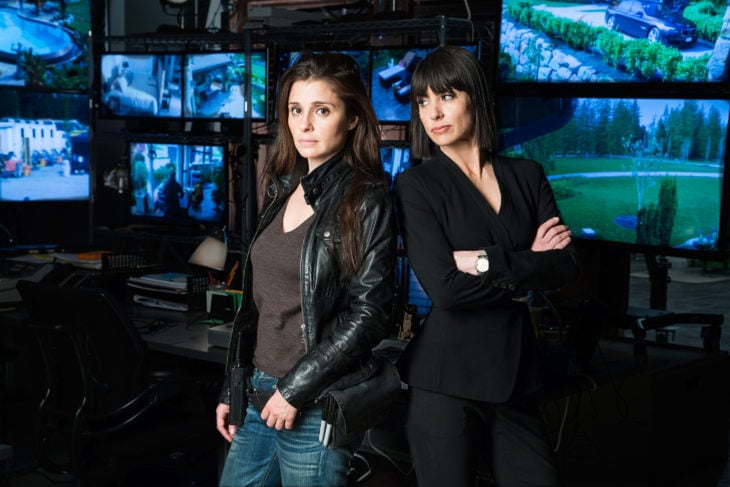
UnREAL: This Is What A Female Anti-Hero Looks Like
When we first meet Rachel Goldberg, one of the main characters on UnREAL — the Lifetime show that’s ushering a new era of female protagonists on TV and at the same time uncovering what goes behind the scenes in a Bachelor-style reality show — she’s wearing a t-shirt that reads: “This is what a Feminist looks like.”
It should really state: This is what a female anti-hero looks like.
Anti-heroes are not a new thing on TV. It’s just that the most famous, the unapologetic ones, the ones who were established as such from the start are typically…well, men.
From Tony Soprano and Don Draper to Walter White himself, the characters we root for even though they’re not exactly the “good guy” have long been a staple of modern TV.
Welcome to a new age of television, one where women can be messed up, manipulative and unapologetically good at what they do.
And we can like them for it.
Rachel and Quinn are, of course, not the first female anti-heroes to have ever existed. In a way, you could say Nancy Botwin from Weeds, Jackie Peyton in Nurse Jackie and, most recently, Piper Chapman from Orange Is the New Black and even Claire Underwood from House of Cards have helped open up the scope of what female characters can and should be.
Anything and everything.
That’s it. That’s the important part. Women can be anything they want.
Even if that means they’re the bad guys.
On UnREAL, however, they like taking things to a whole new level.
Rachel and Quinn are, after all, partially responsible for a whole slew of public humiliations. Basically each and every one of the women gets shamed at some point or another. There is a sexual assault (Maya is raped, make no mistake about it) and even a death (Shia’s desperation to “keep up” with Rachel leads to her to switch Mary’s meds, which leads to Mary’s suicide).
Not only that, Rachel specifically lies to Anna about her father, robbing her of a chance to see him before his death. She also invites Mary’s abusive ex for a visit, setting the stage for her downward spiral, and manipulates Britney into saying what she needs her to say to be able to brand her as “the villain.”
She, of course, does all of this with the blessing and at times, encouragement of Quinn, the original puppet-master.
And that’s just in Season 1.
In the first two episodes of Season 2, Quinn has essentially turned Rachel into a younger version of her, and Rachel has, in turn, corrupted Madison into the kind of person who can use her personal tragedy to get a girl to cry in front of the camera.
Not to mention her manipulation of Beth Anne, which leads her to wear a confederate flag bathing suit in front of the first black suitor in the history of Everlasting.
It’s like they — Quinn and Rachel — don’t care about anything but themselves and the TV show they’re producing.
This is both reprehensible and admirable.
After all, we rooted for Don Draper on Mad Men despite his misogynistic cheating ways, and we really, really wanted Walter and Jesse to get away with everything on Breaking Bad, despite the fact that they were cooking meth. Meth. On TV, it’s not just about good characters, it’s about compelling characters.
UnREAL is all about fascinating female characters.
To begin with, the setting in which these two exist is inherently feminine. Reality TV is not really the place for male-driven stories. Reality TV is, after all, made up of mostly women and watched mostly by women.
So is this show. The creators and producers behind UnREAL are mostly female, and they are not at all apologetic about the fact that they’re telling a female focused/female driven story.
Nor they should be.
What makes this story different, however, is not just the focus, but the lengths they’re willing to go to show that their female characters can be as extreme, as despicable and as conflicted as your favorite male anti-hero.
You think Don Draper and Walter White were bad? Rachel and Quinn are here to show that they can play this game – and they’re not just amateurs. They’re ready for the big leagues.
Typically female roles in these types of productions are a) The encouragement, urging the male character onto even greater misdeeds or b) The nag, who tries to keep the male character from “having fun.”
Case in point – all female characters on the aforementioned shows.
Rachel and Quinn are neither of those. In fact, Rachel, in particular, breaks most stereotypes set in place for female characters.
Neither of them are kind, decent or concerned with doing good, but in general, Rachel isn’t even concerned about her appearance. She doesn’t shower, she hardly ever changes clothes, she wears no makeup, and her hair always looks like a rat’s nest.
Sure, starting in Season 2 we see her dressing a little better, but there’s still a long abyss between her and the type of female characters whose main defining characteristic is “sexy.”
And that’s because UnREAL doesn’t care about your expectations. It doesn’t care about stereotypes. It doesn’t care about the typical ways to “sell” a show like this.
It cares about telling a good story.
Okay, and maybe it also cares a little about that story being a female-driven one.
But that’s okay. That’s exactly what we want it to care about.
Female viewers deserve complex, contradictory, messed up, unredeemable and yet somehow likeable characters. They deserve someone to root for and feel conflicted about.
They deserve to see the full spectrum. They deserve television that accurately reflects the range of what people can be – of what women can be.
And now, thanks to UnREAL, those characters have finally, finally arrived. Let’s just hope they continue to come. Let’s just hope this is more than an anomaly.
Let’s hope this is the beginning.
10 Things We Learned About ‘UnREAL’ at the ATX Television Festival
UnREAL airs Mondays at 10/9c on Lifetime.
Lissete Lanuza Sáenz

Lawyer. Writer. Columnist. Geek. Falls in madly in love with fictional characters. Hates the color yellow, misogyny, and people who are late. Can always be found with a book. Watches an absurd amount of TV every week, often, while eating coffee ice cream. She has no regrets. You can check out her blog here: Absurday. Lissete is a senior writer for Tell-Tale TV. Follow @lizziethat