

Exclusive Excerpt from ‘Talk ‘90s with Me’ by Matt Pais: Interview with Leanna Creel of ‘Saved by the Bell’
The following is an exclusive excerpt from Matt Pais’ new book Talk ‘90s with Me: 23 Unpredictable Conversations with Stars of an Unforgettable Decade, available now in hardcover, paperback, and ebook.
See below for the book’s full description and a selected portion of Pais’ interview with Leanna Creel, who played the memorable and controversial Tori Scott on Saved by the Bell.
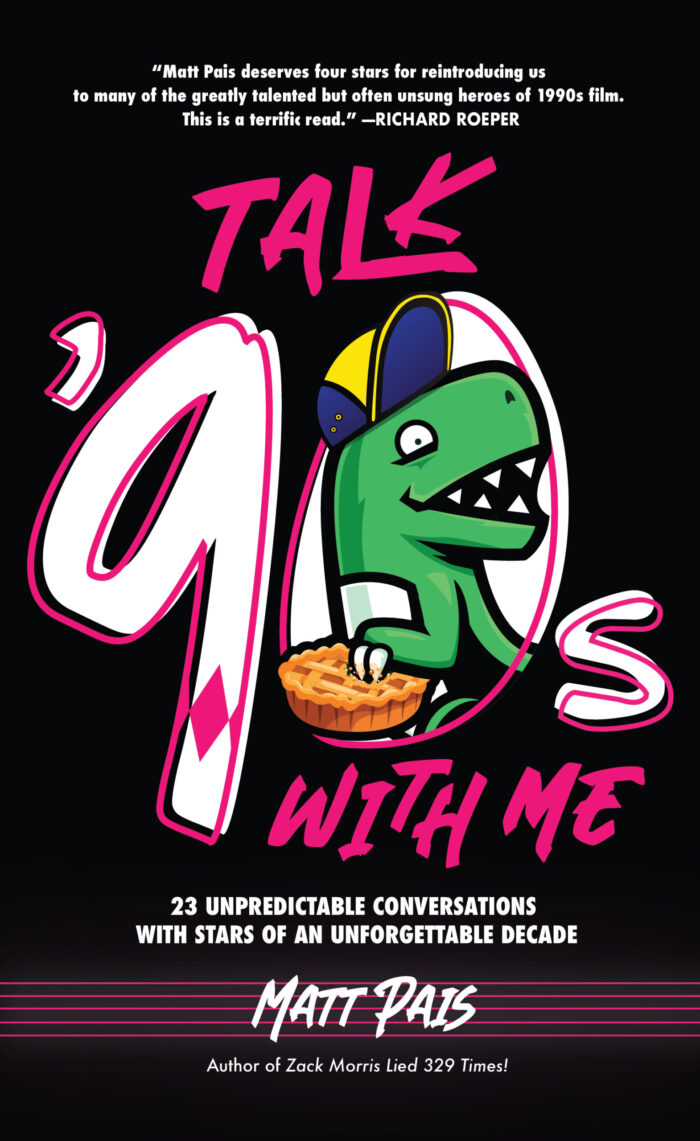
Full Book Description for Talk ’90s With Me by Matt Pais:
“Jurassic Park.” “The Fresh Prince of Bel-Air.” “That Thing You Do!” “Boy Meets World.” “A League of Their Own.” “Home Alone.” “Mighty Morphin Power Rangers.” “Doug.” “Teenage Mutant Ninja Turtles.” “Newsies.” “American Pie.” “Cool Runnings.” “The Mighty Ducks.” These are not just movies and shows. They are legends, and for so many who grew up in the ‘90s, important markers of our childhood. If you could ask the stars behind these classics anything—with the purpose of taking conversations in different directions than any they’ve had before—what would you say? What would you learn?
In “Talk ‘90s with Me,” each interview begins by exploring the subject’s own ‘90s nostalgia and then poses topics they’ve never discussed. It creates a blend of memories and analysis that’s fresh and unexpected, fun and thought-provoking, silly and profound—offering something new to remember (including exclusive, stump-your-friends trivia!) while honoring the movies and shows you’ll never forget.
Maybe it feels like getting a drink with the stars; maybe it just feels like the kind of long phone call that people had a lot more in the ‘90s.
Exclusive Excerpt from Talk ‘90s with Me by Matt Pais: Interview with Leanna Creel of Saved by the Bell
The question all along has been whether or not Tori Scott made sense. Her existence, her role at Bayside, her disappearance. For many, the narrative was always that the short answer was no: Because where were Kelly and Jessie, and why did no one talk about them, and where did Tori disappear to after her 10 episodes.
If you are a “Saved by the Bell” fan, you know all this, and can surely see where this is going: That Chuck Klosterman’s essay about “The Tori Paradox,” included in his 2003 “Sex, Drugs and Cocoa Puffs” collection, over time has threatened to redefine the understanding of Tori. That, Klosterman argues, the bizarre appearance of Tori as a de facto replacement of two-thirds of the gang’s core female characters is in hindsight an accurate portrayal of high school and shifting friendships and cloudy memories. It’s a poetic way of justifying what, in reality, was merely producers wanting to film another batch of episodes after the series had already filmed its high-school graduation episode and Tiffani-Amber Thiessen and Elizabeth Berkley were no longer available.
That’s the elaborate and necessary lead-in to this conversation with Leanna Creel, a legend of sorts even though Tori Scott, a leather-jacket-wearing, motorcycle-riding badass who also didn’t drink and for a short time served as the group’s moral compass, was by far her most significant onscreen credit (aside from, being a triplet, numerous appearances with her sisters in TV movie lead roles [two “Parent Trap” movies!] and smaller parts on “Growing Pains,” “Beverly Hills, 90210,” “Parker Lewis Can’t Lose,” and in 1996’s Reese Witherspoon/Kiefer Sutherland vehicle “Freeway” and 2000’s disturbing “The Cell”). This was by design: Creel never intended to become an actress, really, and in the years since has been a successful film producer (“But I’m a Cheerleader,” “Six-String Samurai”), philanthropist, photographer and content creator through her company Creel Studios.
Wait, though: This is probably an appropriate time to remind you that I wrote a book about “Saved by the Bell” called “Zack Morris Lied 329 Times!” I’d talked with Creel about interviewing her for that project but the timing never worked out, so I was thrilled at her enthusiasm to try again for this book. Before our call I sent her “Zack Morris Lied 329 Times!” but she didn’t have a chance to read it, so for the first 10 minutes or so we talk as she reads portions out loud, leading to exclamations like “It’s so hard to read this stuff!” and “It’s so sexist in a lot of ways” and “[Zack] is such a dick!” She is surprised to learn that “Drinking and Driving” is Zack’s most dishonest episode (13 lies) and that there were no lies in “Slater’s Sister,” and has no recollection of “The Will.” (“Earthquake,” in which Mrs. Belding delivers her baby in a Bayside elevator during an earthquake, is Creel’s favorite.)
It may not be a paradox, but listening to the real Tori read your thoughts about Tori in preparation to talk about Tori and the question of the Tori paradox is certainly some kind of meta example of the world collapsing on itself.

We talked about Tori taking the place of both Kelly and Jessie. What do you remember about the way the character was described initially? Was there a sense that they knew what they were looking for or not really? What did you feel like you were auditioning for?
It was weird. I remember reading for a role like maybe a year or so before. So I knew the show. I didn’t watch it regularly, but I knew about the show, and I had done acting class with Elizabeth Berkley. And I think I met some of the [actors] on the show through some other things. And I remember they told my agent, “Oh, we really liked her. She just wasn’t right for this, but we’ll remember her in the future.” I was like, “Yeah, right. [Laughs] Heard that before.” And then, it was. I just remember, and again this was all when I was going to college so I was busy with school, but I remember I got a call and they worked out the deal, and I don’t remember auditioning for the role. I remember we went in and there were like five of us who went straight to the producers. So we just walked in, one and done. Because they had remembered me, allegedly [Laughs], from some time before. So it was really fast. I think they were just hiring me. I don’t think I really, totally comprehended or understood the weird role that my character was playing as this asynchronous character [Laughs] that comes out of nowhere and is unexplained. I definitely didn’t have an understanding of that at the time at all. I just showed up and went to work, and only much later did I hear that people were [perceiving] my character in some nefarious plot to undermine or get rid of these other characters. I just was unaware of it until a few years ago when the “Saved by the Bell” nostalgia resurfaced, particularly with the Saved by the Max [pop-ups]. I wasn’t aware that my character was so random. It was a random kids’ show, obviously. I remember asking, “Is every single episode a thinly veiled morality tale or commercial for something?” It was like “Teen Line,” drunk driving, earthquake safety. I was like, “They practically turn to the camera and give the social message right to the screen.” So I was kind of learning as I went along. I don’t know how much thought went into it, other than, “Oh, that’s cool. I’m a tomboy.” I remember they even put in my first episode or in the masquerade ball, they were going to have me wear a dress, and I remember marching into the producer’s office and saying, “My character would not wear a dress. Tori definitely would not wear a dress.” [Laughs] I must’ve had some understanding, deep internal monologue about my character being a tomboy and should not wear, would not wear a dress to do the limbo dance or whatever it was. [Laughs] So I think they were figuring it out as well. When we did the show, I brought in—my sister had this, it sounds so ugly now, but it was a motorcycle jacket but it was green leather, and I remember asking if I could wear that. And they were like, “Definitely no. We want you to wear this.” It was just a regular, black leather jacket. I remember being bummed. I’m like, “Can it at least be a biker jacket?” If it had been me, my choice, it would’ve been more of a biker jacket instead of that regular, black leather jacket that was five sizes too big.
What did you think then when the ultimate decision was to put Tori in a dress and have her put a leather jacket over it?
Well, no, no, the dress thing was from the first episode, and that fit my character, I thought, because my character was trying to be something she wasn’t. But in the masquerade ball, they had me back in a dress, and I was like, “No, that’s the whole point. We learned in ‘The New Girl’ to be yourself and not try to change for anybody.” [Laughs] It obviously wasn’t a real deep show. It sounds so arrogant now, but I remember thinking, “Oh my gosh, if adults would leave this show, we kids could do this show in three days a week.” I was already thinking like a producer. [Laughs] Like, “We do not need five days for each of these episodes.” [Laughs] I remember even at that time I must’ve been thinking about becoming a producer because I remember telling Peter Engel that I wanted to be a producer, and I remember he laughed. I look back now, and I think I was probably so precocious. I did look 16 or 17 even though I was older, so I’m sure I came across very precocious and surprising that I would say that. But it was true; I was looking around going, “I want to be Peter Engel. He’s the one that has the power in this situation.” I never was super comfortable in front of the camera, if we’re honest. I’m very comfortable behind the camera. I think I was aware of that even then, even when I was doing the show. Which was one of my first big things. One of my only big things [Laughs], however you want to put it. In front of the camera. I think I’ve been more successful behind the camera for a reason.
So why do you think that Zack Morris has been such an enduring character? When you opened the book, one of your first reactions was to laugh and say, “So sexist.” Why has there been longevity despite his behavior?
It’s interesting. He definitely was filling a stereotype that was very common in the ‘80s and ‘90s, that good-looking jock. But you love to hate him. It’s kind of “boys will be boys.” It was a little bit of that old-school [mentality] … his smile was so cute, he just got away with it. I don’t know. There’s obviously an arrogance to him, but maybe Mark-Paul’s just a super-charming guy. It’s amazing because sometimes it doesn’t feel like we’ve made as much social change, but then when you look back at shows and things because I think it was right around then that MTV was fairly new, and they had that character Pedro came on, and he had HIV, and he was the first gay kid that everybody knew on TV, and it was so radical. We’ve come a long way.
You say Zack is someone people love to hate, but somehow despite Zack’s behavior, Zack and Kelly I think people lump in with Ross and Rachel and these iconic couples no matter the details. I could post something from my book about Zack’s bad behavior, and Mark-Paul in his podcast’s most recent episode says Zack and Kelly have no chemistry, he’s terrible to her, there’s nothing between them and he’d rather watch any other couple, and meanwhile someone will still be really protective of him. People hold their childhood loves close to them, which is fine, but the people who love him love to love him, not hate him, which I think is weird.
It’s sort of like I think how a lot of boys feel about baseball. It’s like, do they really love baseball, or do they really just love that time they got to spend with their dad at baseball games? Do you really love the show, or does it just remind you of those carefree Saturday mornings that you got to watch TV? So maybe it’s just a reminder of that time in our lives when we had less pressures on our lives and it was a simpler time, and everything was so simple and came together at the end with a bow and Zack always learned his lesson. That’s why we tell stories, to remind ourselves that life’s going to be OK, we’re going to get through this, the good guys win in the end. Usually. I don’t know if it’s more of that. And he had a really cute smile! [Laughs] It’s an era. It’s weird to me, honestly. I’ve said this so many times, but I don’t think people really believe me. But if you had told me back then that people would care about this show in 2021, I would’ve laughed. I’m like, “No no no. This is just a dumb Saturday morning show. There’s nothing to it.” So there’s also that je ne sais quoi. That magic quality. I don’t know if it was just because there was no other live-action programming on Saturday morning, and is that why everybody got so emotionally attached? I don’t know. It’s a phenomenon, and you can’t really explain why. Why this show and why not some other show. Yes, it was on in every timeframe and every time schedule around the world, and it’s G-rated and doesn’t have any conflicts, so maybe just numerically it just beat us down. I don’t know. [Laughs] But people are very, very, very attached. I don’t think it even appealed to high-school students at the time. I think it always appealed to junior-high students. So never the reality. It was always an aspirational thing. It was never meant to be real. So it was always this weird fairy tale, I guess.
On the subject of trying to make Tori both Jessie and Kelly at the same time at least for a little while, one of the things I think is great about Tori is that she is the voice of reason in a way they never let Jessie be. Every time Jessie pointed something out from a moral standpoint, Slater would say something sexist, there would be a laugh track, and the point was lost. But Tori, whether in the “Drinking and Driving” episode or identifying that Lisa is being mean to Screech in “Class Rings,” she’s being the moral voice. Yet the show also eventually transitions away from her as a romantic possibility without any explanation, so I wonder if that sort of left the character hung out to dry from the perspective of the people who would be inclined to feel so negatively.
It’s really strange, and definitely an interesting window into the men that wrote the show and their ideas. And their ideal. I think it says a lot more about when they grew up in high school, which was in the ‘50s and ‘60s. It’s hard because when you’re young everybody seems old. Franco [Bario] was young. He was probably still in his 20s or 30s, but the guy that was directing it, Don [Barnhart], I think he was in his 50s. And so was Peter Engel, I think. When you’re still barely out of your teen years, everybody seems like they’re 50. They probably grew up in the ‘50s and ‘60s, so this was sort of a lot of how they remembered high school and the dynamics that were going on for them. And they were working out their issues. [Laughs] Very interesting when you compare it to a show—have you seen HBO Max’s “Generation”?
I haven’t.
So good. And it is so of the moment. And one of the writers is 18 or 19 years old, and you can tell. It feels so of the moment. And there are obviously adults who work on the show and producers and stuff like that, but it does not feel like—it’s the anti-“Saved by the Bell.” [Laughs] It’s like brutally honest and very now. It’s a totally different show, obviously. It’s single-camera and handheld and a little bit “Rashomon”-style. There’s kind of three points of view each episode and the timelines get mixed up. It’s very different. The reason sitcoms have gone away is they’re just so inauthentic. There’s nothing real about that. There’s nothing real about a soundtrack and people basically winking at the audience and saying a dumb joke. I feel like audiences today and youths especially are not going to put up with that. So they demand an authenticity today that [make older shows] just seem so quaint now. Even “Growing Pains” and [“Family Ties”], all those shows, they all seem almost so quaint because they’re all three-to-five cameras and everything’s from the same angle, and it wasn’t really until I was out of grad school and I did some shadowing on “ER” and “The West Wing” and stuff like that, and those shows, it was quite a bit later, but that’s really the first time they were shooting with single-camera and steadicam and even shooting the ceiling, which was so radical. [Laughs] Up until then, people didn’t really do that. I’m having a flashback right now. When I was on “Saved by the Bell,” because remember I said I was a history major, and I went to my advisor and I said, “Can I design a class or an independent study around doing a history of children’s programming in television?” So I went and I got eight units for writing this research paper. And I went and interviewed all these executives at NBC, and it’s interesting because I’m basically doing the same analysis right now for where we are today. There’s a reason for “Saved by the Bell,” where it was, and it was like the first—it’s like they never thought kids would be interested in seeing live-action on Saturday morning. It seems so obvious today. Now it’s 24/7. But back then it was just cartoons. You probably know all this because you’re written the book, literally. And I can’t remember how I was tying that to today other than there’s a 24-hour news cycle that was just beginning back then. And it’s like kids are just used to fact-checking, and they demand authenticity. It’s just such a different era.
I know you said at the time your perspective of what they were doing with the character was just sort of letting it happen in the moment. Was there a statement about feminism that they did make or tried to make with Tori? At first Lisa’s telling her “You’ve gotta turn on the femininity,” and they did allow her to recognize that she wasn’t the dress-wearing type and embrace that, and that’s great, but she also eventually stopped being a romantic possibility, and Screech has a line like, “Just like Tori; not feminine at all.” At the time, was there any alarm bell going off for anyone about what was actually being said about any of that? Or did it just happen quickly and only decades later anyone talked about that?
Yeah, I think, as with the grand tradition of women in Hollywood, we, as characters, are fillers. We fill the stories where we’re needed. We’re girlfriends, we’re best friends, we’re sometimes love interests, sometimes not. That’s how I think—it’s an ongoing, somewhat subconscious thing that the male storytellers have done with our characters. They just use us to fill in the gaps, I guess. [Laughs] As needed. But the focus was definitely on the boy characters, for sure. That’s who Peter related to. He didn’t relate to my character. If there had been women writers and girl writers on the show, maybe they would’ve called out Zack a lot more. [Laughs] Maybe the women would’ve been allowed to be more nuanced. I’d like to believe so. It’s so weird; it’s so hard to even imagine back in that day having a woman director or a woman writer. Isn’t that sad? But I can’t even hardly imagine it from that era.
Yesterday someone who creates graphs to do stats about TV created one about “Saved by the Bell,” charting the number of episodes that were named after each of the main characters. The most frequent times it happened were Zack, Screech, and Slater, with Lisa, Kelly and Jessie falling far behind. It shows where the emphasis was of which characters were thought of as the focal point.
Oh, absolutely! It was all a fantasy. It was all a male fantasy. Absolutely a male fantasy. I had been on a few sitcoms, and often the producer or somebody introduces the cast ahead of time because it’s sort of like a little play. You have a live audience, and you’re about to run through the whole show. I remember the very first night, and Peter Engel, he either ended with Mark-Paul or he started with Mark-Paul, I couldn’t remember, but I definitely saw that he saw himself in Mark-Paul. [Laughs] It was really clear. He was the darling. He was who he saw himself. And maybe that’s how he either wanted to be or saw himself as in high school. I’m sure of it. I guess glee clubs have become cool again because of the show “Glee,” but at the time there were no such thing as glee clubs anywhere! And so to have an episode about that, I feel like we laughed and were like, “Yeah, it’s because these old-timers had glee clubs back in their day.” So we were somewhat aware. I’m pretty sure the other cast would be somewhat aware that there were these weird holdovers from the ‘60s or ‘70s or something that were not consistent with the early ‘90s.
—
Read Talk ‘90s with Me for more from Creel, including if she feels her memories of high school align with Chuck Klosterman’s theory of “the Tori paradox,” why she’s finally ready to talk about her Saved by the Bell experience after years of wanting to set aside that part of her life, and if it’s more ridiculous to deliver a baby in an elevator or get extremely drunk off of one light beer.
Matt Pais is also the author of Zack Morris Lied 329 Times!
 Follow us on Twitter and on
  Instagram!
Want more from Tell-Tale TV? Subscribe to our newsletter here!
Mark-Paul Gosselaar Talks ‘Saved by the Bell,’ Hopes for a ‘Franklin & Bash’ Reunion | GalaxyCon
Tell-Tale TV

Tell-Tale TV is dedicated to offering insightful episodic reviews of a variety of television shows. Our passionate team of writers also works to provide previews, news, in-depth interviews, and other analytical pieces. Tell-Tale TV is a Tomatometer-approved publication.