
Pachinko Review: Chapter Seven (Season 1 Episode 7)
Pachinko Season 1 Episode 7, “Chapter Seven,” represents the Apple TV+ series’ biggest step away from the Min Jin Lee novel it is based on, and the result is one of its best hours to date, an episode that fleshes out one of the story’s least developed central characters in new and interesting ways.
Koh Hansu plays an important role in almost every major part of Sunja’s life—from their initial star-crossed love story to his continued presence in the background during the years that follow. He uses the watch he gave her as a way to keep tabs on her, and it’s implied that he also uses his influence at key moments to help keep her and her family safe.
(Slight spoiler warning, but this behavior will become increasingly explicit later on.)
But, despite the influence he wields throughout (and often over) Sunja’s life, we know very little about what makes Hansu tick or why he is the way he is. He’s not a POV character at any point in the novel and the book grants him little interiority. But apparently, Pachinko has decided it’s time to change that.

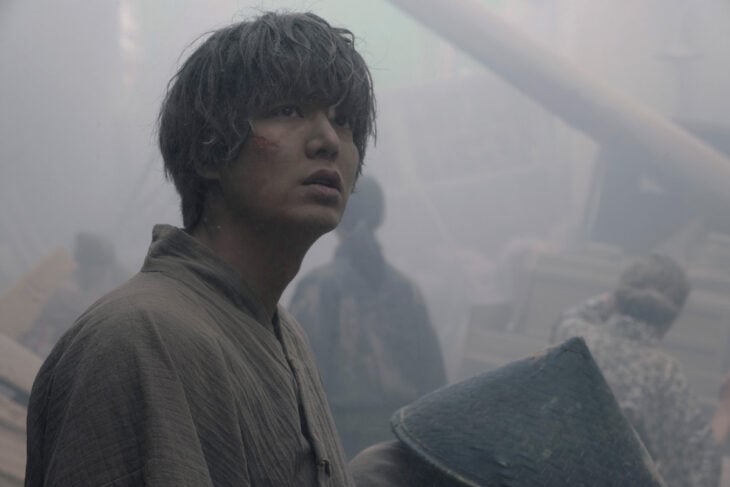
“Chapter Seven” is essentially a bottle episode, a forty-eight-minute flashback to Hansu’s youth in Yokohama. He and his father are Korean immigrants struggling to get by, but Hansu has landed a prestigious job as a math tutor for a rich American family, and hopes they’ll take him with them when they return to the United States.
These dreams are dashed on September 1, 1923, the date Yokohama was struck by a 7.9 magnitude earthquake that destroyed much of the city and killed thousands, as buildings collapsed, fires raged, and a 40-foot high tsunami swept through it. Known as the Great Kanto Earthquake, it is one of the worst natural disasters to ever occur in Japan and one that, sadly, most Westerners likely don’t know much about.
The official death count was around 140,000, as countless houses were either shaken down or burned in the subsequent fires started by the quake. (There was even a fire tornado at one point.) Before the disaster, Yokohama was a center of Japanese optimism and progress. Afterward…it was a horrifying site of mass death.

Pachinko does a fantastic job of portraying the earthquake and the terror of its immediate aftermath. Hansu watches his father die— before the two have made up from a vicious fight over whether or not he should still follow his plan to go to America after learning of a family debt—and then must run for his own life without being able to truly process the scale of his own loss.
The American family he once saw as his way out of Japan is also killed, and Hansu is forced to flee the destruction with Ryoichi, a powerful if somewhat shady local businessman who strangely seems to be a lot like the sort of man Hansu will eventually grow up to become.
There’s truly something heartbreakingly sad about how clear it is that at one point in time, Hansu wanted a very different kind of life, but through no real fault of his own was set on a very different path. (And, having come so close to the death that claimed so many others—is it any wonder that he has a complex relationship with his own Korean and Japanese history?)

The most disturbing aspect of this isn’t the earthquake or the destruction that followed it, it’s the horrific way this tragedy brought out the absolute worst in many of those who survived it.
In the disaster’s immediate aftermath, many Japanese vigilantes, as well as members of the military and the police force, claimed that ethnic Koreans were taking advantage of the tragedy to rob and attack Japanese citizens; that they were in possession of bombs and committing arson; and that they were even poisoning wells.
Gangs of roving vigilante mobs murdered anyone they believed to be Korean on sight, and the horrific sequence in which Hansu hides in a wagon while a gang of Japanese burn a barn full of hiding refugees is only one of many such scenes that took place in the aftermath of the earthquake. All told, nearly 6,000 Koreans were murdered (though some reports claimed the dead numbered as many as 10,000.)
Granted, the mere fact that Hansu lived through something so unimaginably horrible as a young man doesn’t excuse his worst behavior now that he is a grown adult in charge of his own future and capable of both knowing and choosing what is right. But, wow, it sure does add some unexpected layers to his character, as well as a bit more clarity about why he is the way he is.
Stray Thoughts and Observations
- In last week’s episode, we saw Hansu essentially dismiss his wife after receiving news that Sunja has given birth to a son, a choice that seems a bit odd since Noh has been given a different man’s name, and it’s not like he can publicly claim him in the way he’d most like to. (Clearly, the father/son dynamic is very important to him.)
- Given that this is an episode that doesn’t move any of the major stories along, I think we have to assume Pachinko is at least planning to return for a second season?
What did you think of this episode of Pachinko? Share your thoughts in the comments below!
Critic Rating:
User Rating:
New episodes of Pachinko stream Fridays on Apple TV+.
 Follow us on Twitter and on
  Instagram!
Want more from Tell-Tale TV? Subscribe to our newsletter here!
Lacy Baugher

Lacy is a pop culture enthusiast and television critic who loves period dramas, epic fantasy, space adventures, and the female characters everyone says you're supposed to hate. Ninth Doctor enthusiast, Aziraphale girlie, and cat lady, she's a member of the Television Critics Association and Rotten Tomatoes-approved. Find her at LacyMB on all platforms.