
The Spanish Princess Review: Faith (Season 2 Episode 7)
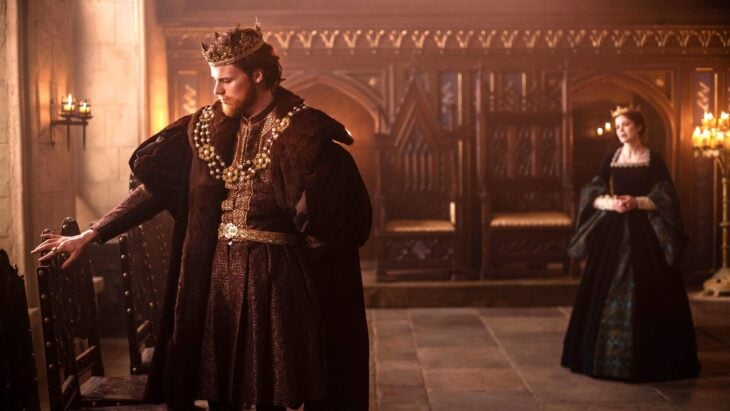
The Spanish Princess Season 2 Episode 7, “Faith,” is perhaps the darkest hour of the series to date, which sees Catherine miscarry another child and Henry decide to execute one of his best friends for (alleged) treason.
Catherine of Aragon is largely remembered as an extremely devout and religious woman. And it’s true — she loved her Church and her God, and this is a big part of the reason she was so adamant that Henry could not dissolve their marriage. (What God has joined together cannot be put asunder, and all that.)
But it must be remembered that sixteenth-century England — in fact, all of Northern Europe — was embroiled in widespread religious upheaval during this time period, such as would ultimately reshape Christianity entirely.
In 1517, the German monk Martin Luther published his 95 theses, which generally condemned the Catholic Church as corrupt. It called the Pope wicked, slammed the practice of buying indulgences — which basically meant paying to forgive sins — and insisted that priests were not needed to translate the Bible for a layperson.
There’s a lot more than this obviously, but this effort at religious reform, which would eventually become known as the Protestant Reformation was an earthquake-level shock. At the time, if you were Christian, you were Catholic.
There were essentially no other denominations, and people would have called you a heretic for suggesting otherwise. (Though people of different faiths — say, Muslims or Jews –were more or less tolerated in public life. For the most part.)
 The threat of reformists was seen as a very real thing and early on in his reign, and Henry actually took it upon himself to try to refute some of Luther’s claims. (Henry saw himself as something of a philosopher-king and many of his writings still survive.)
The king was ultimately given the title of “Defender of the Faith” (Fidei Defenso) by Pope Leo X for his efforts, which included penning the Assertio Septem Sacramentorum (Defense of the Seven Sacraments) in response to Luther’s works.
Which makes it especially ironic that less than a decade later, he would completely break with the Church of Rome, declare himself head of the Church of England, and divorce Catherine on his own authority. And all so he could marry Anne Boleyn.
Whew.
This episode really does do a great job of conveying the increasing darkness that swirled around Henry’s court as the king realized that no one was going to stop him from doing exactly as he wished and that his reach could stretch even into the upper noble echelons of society.
The execution of the Duke of Buckingham — as Charles Brandon rightly notes — marks something of a turning point, as a moment that Henry’s reign turned from something bright and hopeful into something much more frightening.

The bit about Catherine hiding a miscarriage from Henry and the rest of the court didn’t actually happen, though the historical record is spotty enough that we’re still not entirely sure how many children the queen lost over the course of her marriage.
That there were several the court never learned of certainly seems likely — that she simply didn’t tell her husband she lost a child seems less so.
I know that The Spanish Princess isn’t likely to seriously enter the TV awards conversation this year, but truly Charlotte Hope deserves more widespread praise for her complex, heartfelt performance than she’s been getting.
Her Catherine seems constantly racked by fear, frustration, and grief — none of which she is able to fully express to anyone because of her position, and that includes her closest friend. How hard must it be to say out loud that you’re afraid of the man you married?
That she is smart enough to figure out that Wolsey is likely agitating to have Henry put her aside is a nice nod to her abilities, even if we all know she won’t be successful in thwarting his plans.
(Have I mentioned recently that Wolsey sucks? One of the most frustrating parts of this series is the knowledge that we won’t get to see his much-deserved downfall. But thanks in advance, Anne Boleyn.)
With the series finale looming, it’s hard to predict exactly where this series will choose to stop Catherine’s story.
The Spanish Princess has yet to really introduce Anne, though the increased focus on her father (Thomas, the smarmy advisor who suddenly seems to be everywhere) indicates that she may officially enter the fray next week.

But Henry’s love affair with Anne lasted for years, and it took him quite a long time to formally end his marriage to Catherine, an event which ultimately takes place over the objections of the Pope, as well as Catherine’s nephew Charles, who also happens to be Holy Roman Emperor.
There’s a Papal inquiry and a trial at Blackfriars, and the queen’s star dims as Henry forces her to a series of increasingly remote castles on the edges of his kingdom.
(Her resolve, however, never does, and she will go to her death insisting she is Henry’s true wife and England’s queen.)
But as to what the natural endpoint would be for the narrative this show is telling, I don’t know.
The increased focus on Mary may mean that the show will end with Catherine’s vow to fight for her daughter’s rights and cut to black with a reminder that the princess will one day fight her way to her crown, the way her mother and grandmother before her have done.
I think that’s the ending I’d like the best — one which emphasizes the fight Catherine put up, rather than the fact that she ultimately didn’t win it.
The true victory of this series is that it’s made me care enough about this queen to not want to see her fall.
Stray Thoughts and Observations
- Truly, Catherine and Lina’s friendship is the best part of this show.
- Fun fact: Edward Stafford’s father was executed by King Richard III. (And as a descendant of King Edward III, the Duke of Buckingham likely had a stronger claim to the throne than Henry himself did.)
- Maggie Pole truly shouldn’t have been surprised at the lengths Thomas More would be willing to go in the name of his faith. More will eventually be thrown in the Tower of London for refusing to support Henry’s attempt to annul his marriage to Catherine and is ultimately beheaded for his insistence that the king cannot be head of the church in England.
- One of the more disappointing aspects of this season is that Meg’s story can’t possibly be treated with the nuance and the depth that it deserves. (It’s honestly even more bizarre than the events depicted here, and she and Angus got back together multiple times before splitting up again.) The show is doing what it can, showing the growing rift between the two queens as Meg illuminates a path her brother will attempt to follow her down very shortly, but I’d love to see more of the Scottish politics of all this. Give us a sequel, Starz!
What did you think of this episode of The Spanish Princess? Share your thoughts in the comments below!
Critic Rating:
User Rating:
The Spanish Princess airs Sundays at 8/7c on Starz.
 Follow us on Twitter and on
  Instagram!
Want more from Tell-Tale TV? Subscribe to our newsletter here!
Why ‘The Spanish Princess’ Is Exactly the Kind of Period Drama We Need More Of
Lacy Baugher

Lacy is a pop culture enthusiast and television critic who loves period dramas, epic fantasy, space adventures, and the female characters everyone says you're supposed to hate. Ninth Doctor enthusiast, Aziraphale girlie, and cat lady, she's a member of the Television Critics Association and Rotten Tomatoes-approved. Find her at LacyMB on all platforms.
One thought on “The Spanish Princess Review: Faith (Season 2 Episode 7)”
Couples of quibbles:
Re: There were essentially no other denominations
Orthodox Christianity existed in eastern Europe and the Middle East, and there were Copts, Nestorians and so forth scattered here and there. But the Catholic Church was THE church in western Europe.
Re: the Duke of Buckingham likely had a stronger claim to the throne than Henry himself did.
Not really, Henry was royal on both sides. He inherited the Lancastrian claim on the crown from his father, and the York claim on the crown from his mother. He and Stafford were cousins multiple times over but the dukes of Buckingham came from a younger son of Edward III.
Comments are closed.