
The Spanish Princess Review: Flodden (Season 2 Episode 2)
Every woman who has ever had to make herself look small in order to (maybe) make a man feel better will find The Spanish Princess Season 2 Episode 2, “Flodden,” familiar, an hour that spends the bulk of its time showing us in great detail that Catherine is a better ruler, leader and general in almost every way than Henry is.
Yet, despite that fact, she must repeatedly downplay and diminish her own achievements so as not to overshadow her husband.
Modern viewers of today may not really understand — or care about — the various machinations and land grabs by the Scots at England’s Northern border. But this rage, that anger of being a woman doing the work yourself, only for a man to take credit for it? That’s a story every female viewer tuning in understands.
“Flodden”, you may be surprised to know, is based on true, real-life events. This is another of those truly impressive aspects of Catherine’s life that tend to be swallowed up by the tragedy of its end, but most of it really did happen.

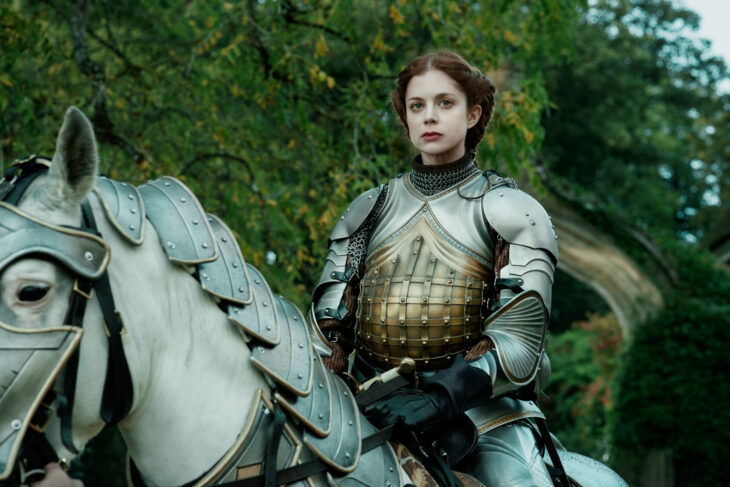
She was left as Regent of England when Henry left to “fight the French” (read: sort of ride around aimlessly and then declare victory). She mobilized resources, raised soldiers, engaged in strategy sessions, and even went north herself, with what is assumed as the intention of supervising the fighting and planning.
Unfortunately, the idea that she rode out clad in a set of specially designed pregnancy armor is probably an exaggeration, but there are real-life reports that she gave a “splendid oration” to her English captains in “imitation of her mother, Isabella” who was well known as a conqueror and warrior queen.
But true or not, the visual is honestly amazing, and it’s the sort of imaginative thinking this series of Tudor dramas has often indulged in, but that The Spanish Princess, in particular, excels at. And I’m not mad about in the slightest.

It’s a truth of Catherine’s life — that she was brave, that she was a fighter, that she was willing to take risks for her adopted country and its people — that deserves to be remembered alongside the fact that she is eventually thrown over for another woman.
There’s so much to love about this moment and the fact that, for the briefest moment, Catherine had it all, as a wife, a queen, and a ruler.
It’s hard to say whether her reign may have ever had a moment to equal this one, and it’s so satisfying to watch her experience it, even if she must spend virtually every moment afterward downplaying what she did.
That her actions — which were smart and correct at the moment — will probably inevitably be blamed for the loss of a(nother) child and heir for England is made all the more heartbreaking by the fact that the show takes so many moments to show us how (rightly) proud she is of what she’s accomplished.

Not just that — it shows us just how proud other women are of what she’s done. Mary, Maggie, and Catherine’s new lady who is not Rosa whose name I don’t think I’ve ever managed to catch are all in straight-up awe of her. And they should be.
In England, this sort of thing is largely unprecedented. (Or, at the very least, hasn’t come close to happening for several hundred years.) Catherine, in her way, is a trailblazer for the women — and queens — who would come after her.
Both her daughter Mary, as well as her daughter’s half-sister Elizabeth, would one day claim power, leadership, and command for themselves. And they were allowed to do so in part because Catherine went first, and showed her new country that women can be every inch as capable as men.
Sadly, Catherine’s story is still largely remembered because she failed at the duty that her time most expected from women: Producing a son and heir.
That fact alone was enough to condemn her, and even when measured against all her other strengths and accomplishments (which, as we can see, were many) meant she would always be found wanting.
And that is the true tragedy at work here.
Stray Thoughts and Observations
- The Spanish Princess actually goes pretty easy on Catherine in the aftermath of the Battle of Flodden. Here, she very kindly allows Meg to take her husband’s body home to Scotland and encourages her to grieve his loss. That is…not precisely what happened in real life. Catherine very much wanted to take King James’ body to Henry as a sort of war trophy, so that he could basically wave him around and prove he was dead at England’s hand. (Imposters were often a thing, in these times.) She was only prevented from doing so because “our Englishmen’s hearts would not suffer it” she wrote at the time.
- Henry’s rude treatment of Thomas Howard is particularly ironic given that he will ultimately turn out to be the grandfather of not one but two women that the king himself later marries (Anne Boleyn and Katherine Howard). It’s also not entirely accurate; the real Howard was richly rewarded for his role in the Battle of Flodden and was restored to his family’s title of Duke of Norfolk roughly six months later.
- Uggggh, Bessie Blount. I know her presence is historically accurate — Blount would eventually be one of Henry’s most long-term, well-documented mistresses — but some part of me can’t help hoping Henry will catch a clue this time around. Catherine deserves better!
- I am not sure I’ve ever seen an onscreen version of Thomas Wolsey I didn’t want to punch in the face almost immediately, but whew, Philip Cumbus deserves props for being particularly punchable.
- Speaking of Thomases, this episode did not have nearly enough Thomas More in it.
- Random fun fact: James IV of Scotland did indeed die at Flodden, becoming the last monarch of the British Isles to die in battle.
What did you think of this episode of The Spanish Princess? Share your thoughts in the comments below!
Critic Rating:
User Rating:
The Spanish Princess airs Sundays at 8/7c on Starz.
 Follow us on Twitter and on
  Instagram!
Want more from Tell-Tale TV? Subscribe to our newsletter here!
Why ‘The Spanish Princess’ Is Exactly the Kind of Period Drama We Need More Of
Lacy Baugher

Lacy is a pop culture enthusiast and television critic who loves period dramas, epic fantasy, space adventures, and the female characters everyone says you're supposed to hate. Ninth Doctor enthusiast, Aziraphale girlie, and cat lady, she's a member of the Television Critics Association and Rotten Tomatoes-approved. Find her at LacyMB on all platforms.
2 comments
Even Sam Neill as Wolsey?
My last name is Flodeen!
Comments are closed.