

The Irishman Review: Scorsese’s Epic Mob Drama Puts De Niro In The Middle
The Irishman shows how tough it is being the middleman even if you’re a mafia tough guy.
Prolific director Martin Scorsese gives us this sprawling tale in a movie that feels somewhere between a small arthouse film and a major blockbuster but is in a class all its own.
Based on the book, I Heard You Paint Houses, by Charles Brandt, The Irishman follows Frank Sheeran, played by Robert De Niro, in his career as a mafia hitman and labor union official. This story and Scorsese are a natural fit—both epic sagas and the mobster milieu can be found within his impressive filmography.

Similarities are drawn to Casino and Goodfellas with the subject matter and style, this insider glimpse into the world of organized crime. Goodfellas, which is also based on a non-fiction book, Wiseguy by Nicholas Pileggi, employs narration as well, giving the viewer a fly-on-the-wall feeling.
The Irishman is a quiet study of a quiet man who is smack dab in the center of the mob dealings of the Bufalino family and the inner workings of the Teamsters union led by general president, Jimmy Hoffa (Al Pacino). Scorsese paints this middleman’s story with long, slow, intentional strokes with all the tension that comes with being stuck in the middle of two volatile organizations and their figureheads.
The middleman theme is perhaps the most overt, but is never heavy-handed. De Niro is even in the middle on the film’s poster between Pacino and Joe Pesci, who plays mob boss Russell Bufalino. Frank considers both of these men his friends and then is put in the toughest position of all.
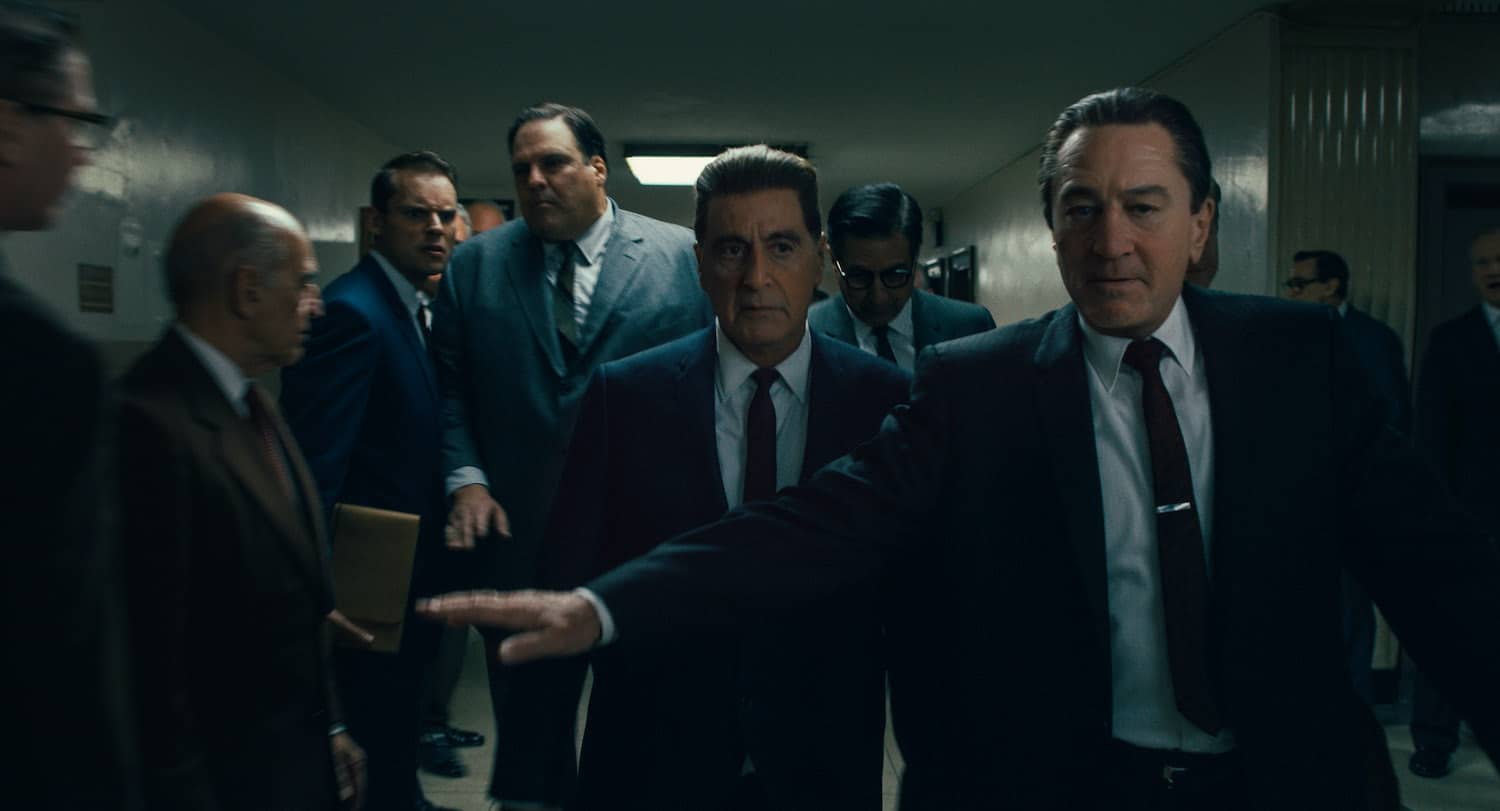
When Frank unknowingly takes a side job that is not in the interest of a connected crime family, Russell vouches for him, leading boss Angelo Bruno (Harvey Keitel) to tell him just how important that friendship is.
Angelo: You got a good friend here. You don’t know how good a friend you got.
Russell sits quietly during this. Russell is often quiet and low key, more than even Frank, and the complete opposite of Jimmy Hoffa, who is excitable and passionate with a quick temper.
De Niro’s performance sits in the middle of the spectrum between Pesci’s restrained Russell and Pacino’s impetuous Jimmy. We aren’t hit over the head with this, though, it is evident through wonderfully-paced scenes and subtle nuances in each of their portrayals.
Jimmy’s freak outs are so entertaining. He is larger than life and it is fun to watch. Russell is so reserved that it is unnerving which adds to the gravitas of his position.
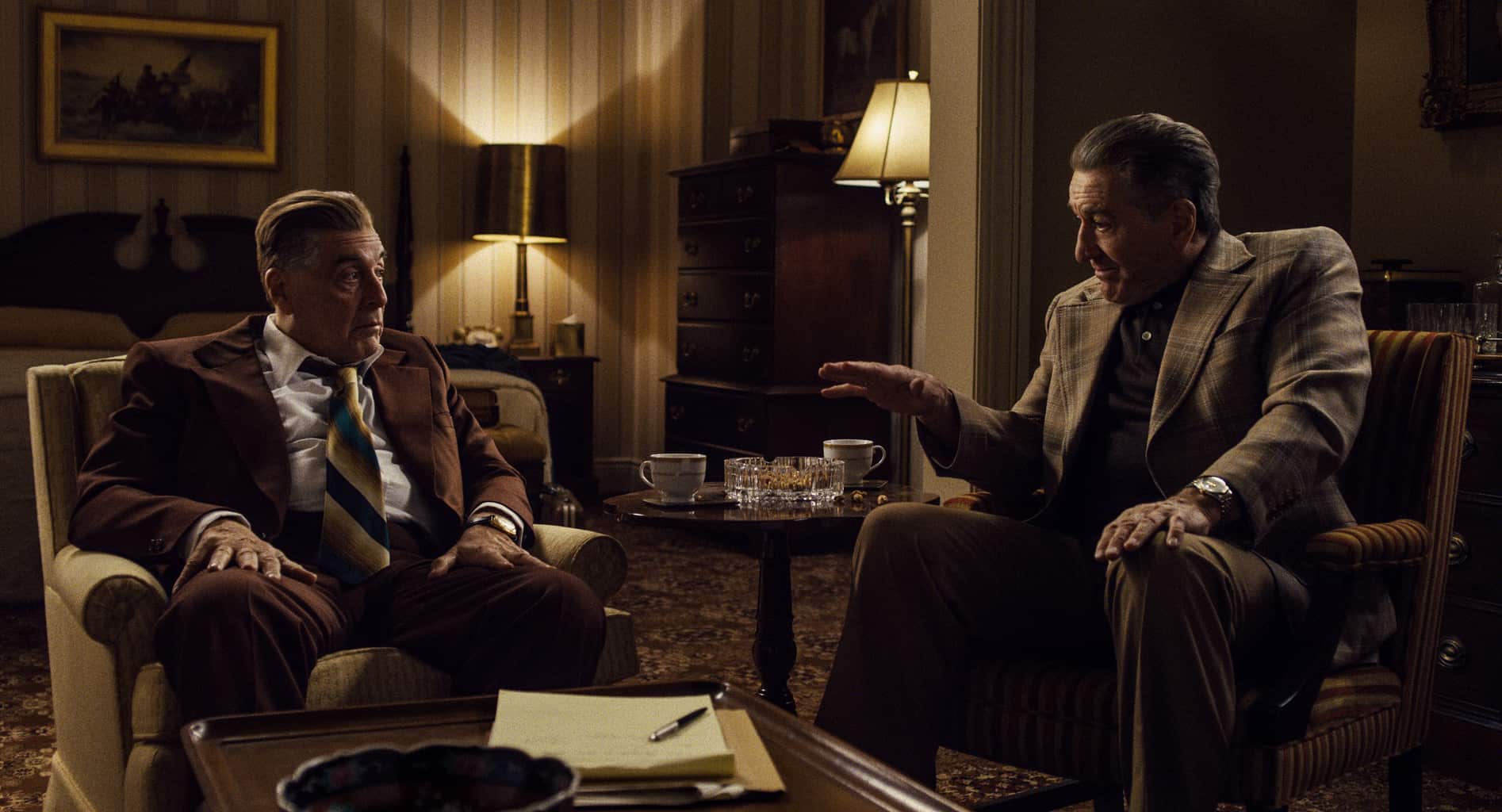
The two polar personalities draw in and repel Frank’s daughter, Peggy. She is enamored of Jimmy and wary of Russell, and her attitude around the two of them is night and day.
Also, it’s worth noting that Peggy is a middle child of four, and the focus is on her the most out of Frank’s children.
Not only does Peggy’s role demonstrate the the two sides of her father’s conundrum, but the consequences of his actions, too. The young Peggy (Lucy Gallina) doesn’t say a whole lot and the older Peggy (Anna Paquin) says even less, really underscoring the silence that Frank himself feels from her.
Most of their scenes together consist of looks. Peggy’s seems to be a knowing look even if it’s just skepticism, and when Frank looks back, it’s almost as if it confirms all her suspicions.
This dynamic is thoughtfully nurtured throughout the film and it makes her final pointed line to Frank all the more powerful as well as their subsequent estrangement initiated and maintained by her to the end.
Frank: I should call Jo.
Irene: You haven’t called Jo yet?
Peggy: Why?
Frank: What?
Peggy: Why?
Frank: Why what?
Peggy: Why haven’t you called Jo?
Frank: [long pause] I’m gonna call her now.
In that phone call to Jo (Welker White), Frank is notably flustered, and De Niro does this great stammering thing. We see him get like this a couple times and it is effective in showing how the stakes keep raising. Frank is very even-keel, so to see him rattled, in turn, rattles the viewer.
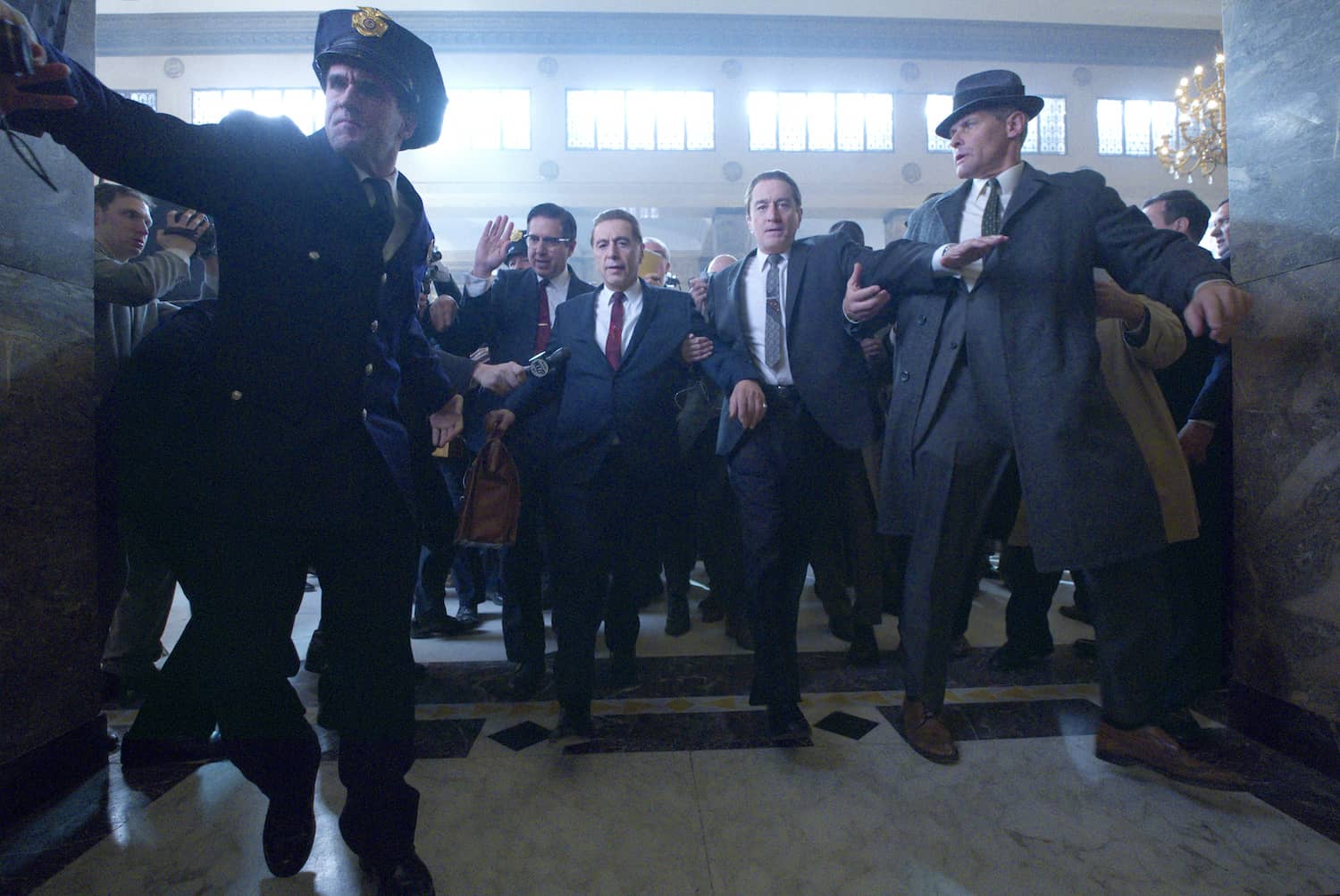
Although we can foresee that Frank is going to have to be the one to do the hit on Jimmy, it is, nevertheless, shocking. The direction, acting, camera work, and editing all play a part in making it so. The hit lasts about 30 seconds and so much is conveyed in that short amount of time.
It seems like Frank hesitates at first and you wonder if he will actually go through with it. Then Jimmy goes back to the door and is mostly out frame when Frank shoots him; and Jimmy’s “Oh!” is devastating to hear when we aren’t completely seeing.
Frank’s close-up shows his emotion even as he stoically goes through the motions of a hit job. Then there’s a wide shot that shows the blood splatter on the wall and you can’t help but think back to the beginning, “I heard you paint houses.”
The whole film has been leading up to this moment, closing in on three hours, and the payoff is executed brilliantly.
Another prominent theme is doors left slightly open. Young Peggy watches her father pack a gun into a suitcase through her bedroom door and when she asks where he is going, he replies, “I’m going to work.”
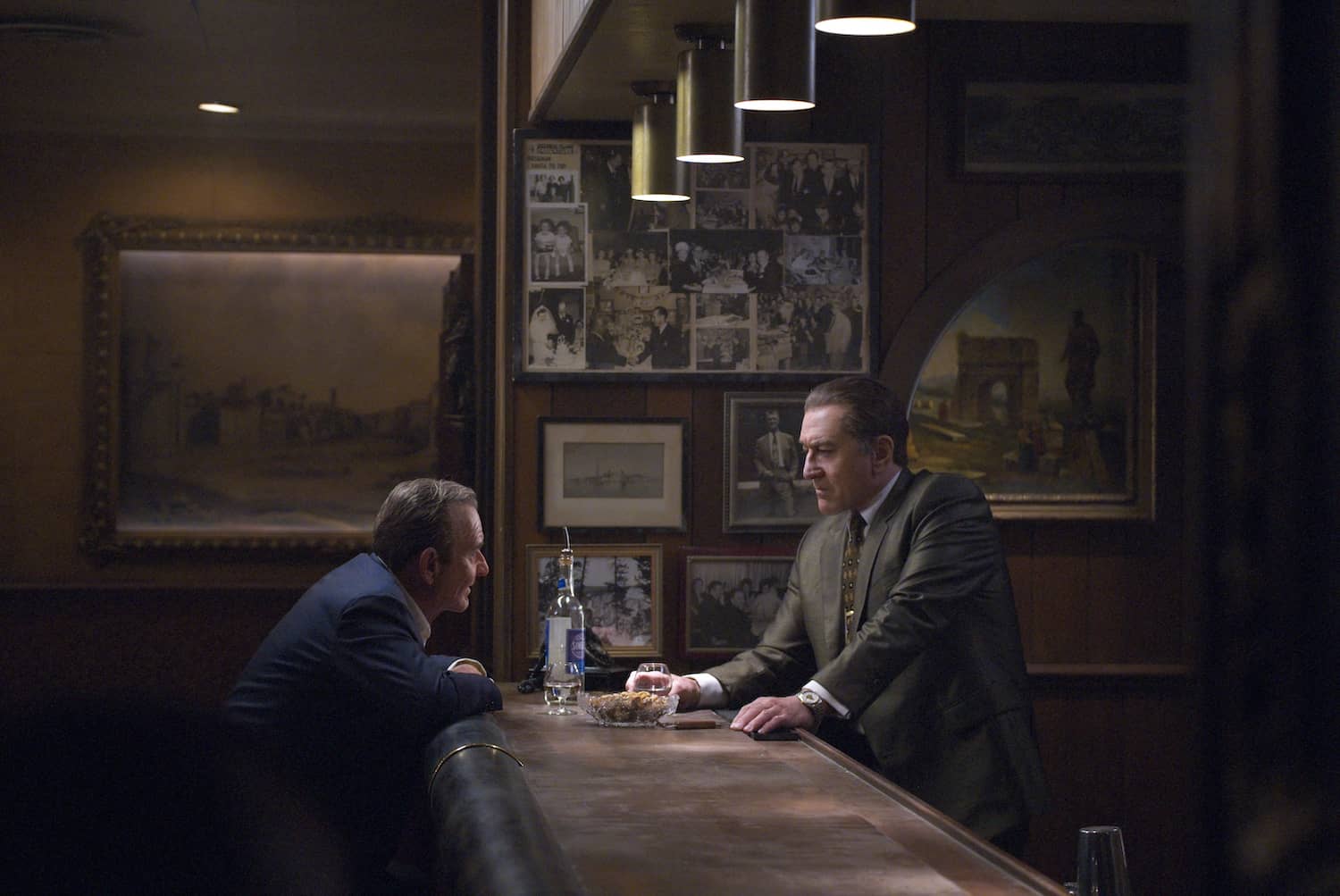
When Frank stays in a hotel suite with Jimmy for the first time, Jimmy leaves the door to his room open just a crack. There is a close-up of this. Personally, I read this as Jimmy leaving the possibility of trust and friendship between him and Frank open, and after that the two men quickly become close.
At the end, there are a couple of scenes with Frank and a priest. It seems he has confessed his sins and he says that “the intention was there,” an intention of praying for absolution. Although he struggles with clearly saying that he’s remorseful, with the priest’s help he can see that the possibility of divine forgiveness is there.
Frank: Hey, Father. Can you do me a favor? Don’t shut the door all the way. I don’t like that. Just leave it open a little bit.
It also links back to when his friendship with Jimmy was beginning to form which gives more weight behind the ambiguity of his confession.
Scorsese delivers a powerful film with this stellar cast of heavy Hollywood hitters. That much is expected, so it makes the unexpected nuance and detail all the better.
It’s incredible when something can live up to and surpass the hype—The Irishman is already a classic, instantly time-honored, and will pass through that slightly open door into the annals of great American cinema.

Stray Observations:
- There’s something comforting seeing Joe Pesci and Robert De Niro side by side in the first few minutes of the film.
- “Are you looking at my ears?”
- Some advice from Jimmy Hoffa: “Charge with a gun. With a knife, you run.”
- The scenes/fights with Jimmy and Tony are the best—reminiscent of the “How am I funny?” scene in Goodfellas, that same kind of wiseguy humor.
- In a disagreement between Jimmy and Tony about how much time constitutes an excuse to use for being late due to traffic, Jimmy says ten minutes and Tony says it’s fifteen. Frank interjects with “How about twelve and a half minutes?”—always in the middle.
- “They’re all named Tony.”
- The film spans decades. The hair and makeup is well done to show the different time periods, for the most part. However, Russell kind of looks old throughout. That being said, Pesci plays really old really well.
- Those final scenes with Frank and Russell in prison are incredibly well-acted, and it is a nice touch with the bread and grape juice.
What did you think of The Irishman? Share your thoughts in the comments below!
Critic Rating:
User Rating:
The Irishman is currently streaming on Netflix.
 Follow us on Twitter and on
  Instagram!
Want more from Tell-Tale TV? Subscribe to our newsletter here!
Erin Allen

Erin is a former script supervisor for film and television. She's an avid fan of middle aged actresses, dark dramas, and irreverent comedies. She loves to read actual books and X-Files fan fiction. Her other passions include pointing out feminist issues, shipping Mulder and Scully, and collecting pop culture mugs.