
This Is Us Military Advisor James LaPorta Discusses the Inspiration for Cassidy Sharp and Season 4’s Military Storylines
There’s a reason for the authenticity of the military storylines we’ve seen so far in This Is Us Season 4.
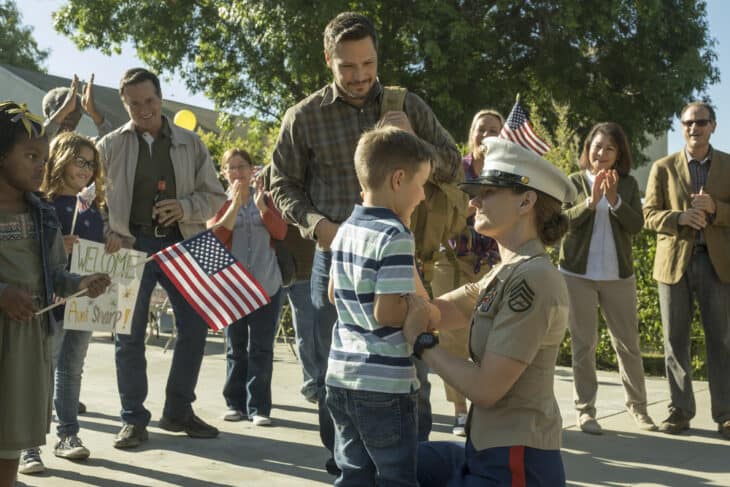
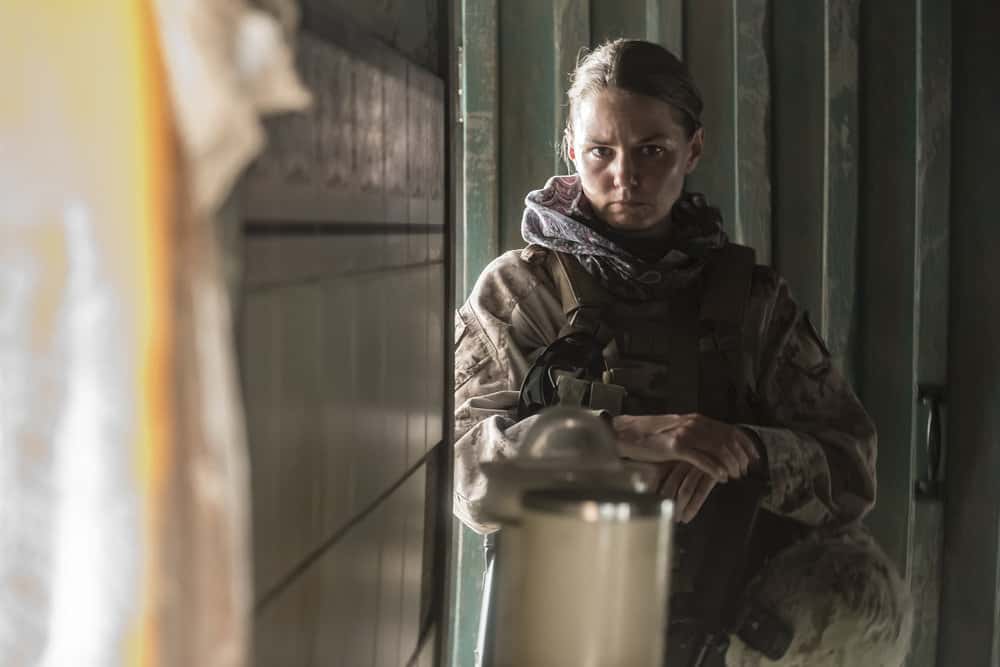
Season 4 has not only introduced the character of Cassidy Sharp (Jennifer Morrison), a Marine who struggles to adjust to life at home when she returns from Afghanistan, but it’s also giving more attention to Jack’s brother, Nicky Pearson (Griffin Dunne).
The show’s military advisor, James LaPorta, has helped to make sure these storylines are based in reality. In fact, much of what we’ve seen with these characters so far this season comes from his own experiences or experiences of people he knows.
I recently spoke with LaPorta, who is a Marine Corp veteran and a reporter for Newsweek, about the real-life inspirations for what we’ve seen so far this season and how he wound up working as a technical consultant for the series.
LaPorta said he started out as a fan of This Is Us. He was struck by the Vietnam story in Season 3 and how much the show was getting right. So he reached out to set up an interview for Newsweek with creator and Executive Producer Dan Fogelman.
“About an hour before I was supposed to do the interview, I had gotten word that a marine I had served with had taken their own life. So I got on the phone with them, and I broke down. I just couldn’t hold it together. [I was] crying profusely because the whole interview was about war and about coming home from war,” he said. “I was incredibly embarrassed and I felt it was very unprofessional for me to be breaking down over the phone.”
LaPorta then apologized after the interview, and Fogelman reached out to tell him he was being too hard on himself.
“I stayed in touch with Dan since then and that’s how it came to be. He brought me out to the studio, showed me around the studio, and wanted me to meet with the staff writers. It was supposed to only be about a 15-minute meeting and it turned into a two-hour-long meeting,” he remembered. After that, they offered to hire him as a technical consultant for the next season.
LaPorta’s own experiences in the military were key to developing the character of Cassidy Sharp.
“I can pretty much tie everything in her story arc or how she is as a person to either my own experiences, experiences of people that I know, or some fact or statistic. Her story is very truthful in many ways,” LaPorta said. He also felt it was important the character be female.
“Shannon Kent was a senior chief petty officer in the Navy who did the exact same job Cassidy does. She collects counterintelligence and human intelligence. She was killed in Syria,” he explained.
“Those of us who covered the military in journalism were not shocked. We’ve known women have been serving in these classified settings for a while — in these front line positions. But for the rest of the American people, they were taken aback that a woman would be serving and have served their entire career with special operations and special forces in these high level classified missions.”
“That, to me, signaled a problem that not only are female service members underrepresented in film, they’re just underrepresented in general in terms of their point of view,” LaPorta continued.
He said that Cassidy isn’t just inspired by Shannon Kent, but that shes’s inspired by a lot of different people, including two female Marines he used to work with. “She’s mostly me in terms of my background in the military. But her being female and what her job is, that is all inspired by others — all real life.”
Cassidy’s last name, Sharp, is also significant. It pays tribute to Lance Cpl. Charles “Seth” Sharp of Adairsville, Georgia.
“One of the most difficult scenes for me in the first episode [of Season 4] didn’t even occur to me when I was helping write it,” LaPorta revealed. “Cassidy’s coming home and she gets out. And I just happened to notice one of the background extras was holding a sign that says ‘Welcome home, Sharp.’ And it occurred to me that Lance Cpl. Sharp never got that.”
LaPorta also discussed the scene in which Cassidy has a flashback involving the condolence payments and hits her son because of it. LaPorta said even the detail of the condolence payments is very real and that the scene itself came from something that had happened to him.
“I had watched a five-year-old step on an IED,” he explained. He then described being back home years later and listening to a song by The Lumineers. His three-year-old son was jumping up and down, and that image transported him back to watching the Afghan child jumping on an IED.
“I didn’t hit my kid. That did not occur. But the whole illustration behind what happens to Cassidy in that first episode in terms of getting transported back was the idea that post-traumatic stress triggers can be things that you would never connect to war,” he noted. “For her, it was the fact that their broken hot water heater costs more than what they paid for someone’s life, which not only is incredibly sad, but it’s also incredibly true.”
LaPorta shared that he is “grateful that the show is connecting with veterans from multiple generations,” noting the accuracy of what Jack deals with on This is Us Season 4 Episode 1, “Strangers,” when he meets Rebecca’s parents and defends the Vietnam war as being a “real” war.
He has since heard from Vietnam veterans about the accuracy of such a statement, and he explained that many Vietnam veterans were told it wasn’t a real war by those who had served in WWII or Korea.
The storylines we’re seeing involving present-day Nicky Pearson this season are also based in reality. One example LaPorta gave was the reasoning behind Nicky throwing the chair through the window.
“That was taken out of my own experiences,” LaPorta said. “I’d gotten home from Afghanistan in 2009. It was a tough deployment. We lost 14 marines that year and I went into therapy. And the problem is where I was stationed, there were a lot of Marines who needed therapy but not enough therapists. So therapists [would] get burnt out and quit, they would get transferred to another facility, or you would have therapy sessions that were months between sessions.”
“I finally found this doctor that I really started to trust and build rapport with, and I started to progress and get better in my own treatment, and they retired,” he continued. “For me, it was like starting at square one, like being abandoned. And that’s how Nicky feels.”

Those kinds of details are exactly what make LaPorta’s job on the show so important. He said that he hoped to be able to help offer stories that are “universal to every veteran’s experience” whether it’s for someone trying to get mental health services, who is still serving in the military, or who is going through the Department of Veterans Affairs.
“I also wanted them to see the good side. That if you’re going to therapy, and you keep working in therapy, you can get better.”
Along those lines, LaPorta recalled a moment from This Is Us Season 2 that he said he personally needed at that time and was grateful for. That was also the moment that made him decide to reach out to the show initially.
“It’s the moment when Jack takes Randall to the Vietnam Memorial Wall, and we learn that Jack is a veteran. Jack sits Randall down and he says, ‘You’re going to find your balance [Randall], and then you’re going to lose it, and then you’re going to find it again,'” LaPorta remembered.
“I really needed to hear that as a veteran, because the transition from the military to civilian life is incredibly difficult when you’re trying to sort through what happens in war and why war happens.” LaPorta said he hopes the storylines with Cassidy, Nicky, and Jack “will resonate with other veterans. And from what I can tell, they are.”
—
This Is Us airs Tuesdays at 9/8c on NBC.
 Follow us on Twitter and on
  Instagram!
Want more from Tell-Tale TV? Subscribe to our newsletter here!
Ashley Bissette Sumerel

Ashley Bissette Sumerel is a television and film critic living in Wilmington, North Carolina. She is editor-in-chief of Tell-Tale TV as well as Eulalie Magazine. Ashley has also written for outlets such as Rolling Stone, Paste Magazine, and Insider. Ashley has been a member of the Critics Choice Association since 2017 and is a Rotten Tomatoes-approved critic. In addition to her work as an editor and critic, Ashley teaches Entertainment Journalism, Composition, and Literature at the University of North Carolina Wilmington.