
Fosse/Verdon Review: All I Care About Is Love (Season 1 Episode 6)
More than any other episode this season, Fosse/Verdon Season 1 Episode 6 “All I Care About Is Love” is the one most focused on trying to see beyond Bob Fosse’s mystique.
Similar to Fosse/Verdon Season 1 Episode 4 “Glory” where Bob overly identified with the protagonist of Pippin, on this episode, Bob envisions himself as comedian Lenny, the protagonist of his Lenny Bruce biopic, using this as a vehicle to reflect on his own life.
Lenny and Bob have some things in common: both married to dancers, they struggled with — and attempted to resist — criticism that their work should be more palatable, choosing to push the envelope with dark, controversial material.
It’s not hard to see why Bob was drawn to the project. It’s also worth noting that similar to Fosse/Verdon, Lenny has a non-linear structure as well, using juxtaposition and editing in a fashion not dissimilar to Fosse/Verdon. Truly, there are so many layers to what the show runners are doing here.

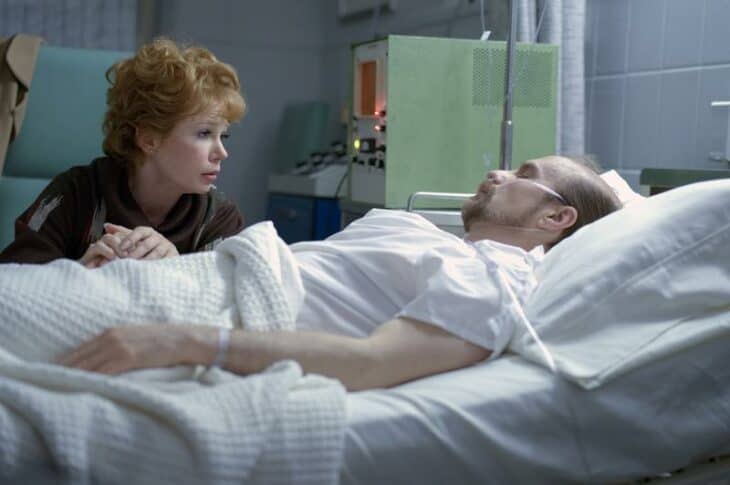
Bob’s decision to work on Lenny and Chicago simultaneously comes back to haunt him as he suffers a heart attack and much of the episode moves back and forth between imagined stand-up sequences and the visage of Bob in a hospital bed.
Weakened and robbed of his physicality and presence, Bob seems small for the first time. Rockwell looks truly terrible, and I mean that in a good way. It’s an egoless performance (Bob Fosse would never!) and it’s Rockwell’s strongest work of the season.
What’s most fascinating are Bob’s ruminations on his desire for love and how this ties to his desire for applause. While he brusquely quips something akin to “the main difference between sex and applause is that you only applaud someone you love,” it’s clear that belief drives him.

It’s also perhaps why his relationship with Gwen differed so much from his other relationships and was so hard to untangle. His partnership with Gwen wasn’t just about love, it was part and parcel with applause and adulation.
Applause equals love and when Bob lies in his bed, it’s telling that he imagines applause, not his loved ones.
The show flashes back to his childhood, where we start to get an understanding of why — and how — Bob became this way. There are fissures in his relationship with his parents.
After coming home from a professional dancing job, Bob’s father spits at him that he looks like a faggot in his stage makeup while his mother seems disappointed he did not bring home more earnings; there’s no talk of pride or cheers for his success.

This is juxtaposed with the adulation of older women working at a burlesque house, who fawn over him after his performance and applaud him from the wings. Is it any wonder that he fell into a bad situation while in search of some love and care?
For those familiar with All That Jazz, the revelation that Bob was molested and sexualized at a young age won’t come as a surprise, but even if you have that advance knowledge, it’s still jarring and devastating to see the trauma and its after effects.
That abuse — because it is abuse, even if Bob did not initially digest it that way — undoubtedly fueled Bob’s hyper sexualized nature (and his hyper sexualized choreography) and kicked off a dangerous push-pull relationship between Bob, praise, sex, and love. These things were easily conflated and confused in his mind.
Sometimes it seems as though Fosse/Verdon lets Bob off too easy; over and over again, Gwen receives a more magnanimous edit but still, Bob is portrayed as a tortured creative genius who yes, was an asshole, but, oh, his art! Bob’s past traumas, as portrayed on this episode, certainly don’t erase or excuse his discretions and insensitivities but it does help explain some of them.
Bob’s hubris was mostly for show and it starts to make sense why some of his works focused so much on how life is a performance. He lived that. Show business, performance, all of that jazz, so to speak, was his escape but it was also so strongly tied with pain. But he could not quit it.

Other highlights of this episode included a harrowing scene with Margaret Qualley, who pitifully lies to a kind person in the hospital waiting room that Bob is her husband. Qualley is a real find and she manages to convey so much with her eyes — weariness, shame, worry, embarassment.

Bianca Marroquin makes a significant impression as Chita Rivera. The Chicago sequences on this episode were less than I anticipated they would be given the title of the episode but Marroquin (who has appeared as Roxie in Chicago on Broadway — talk about meta!) is striking despite her limited screen time and I look forward to seeing her more next week.
What did you think of this episode of Fosse/Verdon? Share your thoughts in the comments below!
Critic Rating:
User Rating:
Fosse/Verdon airs Tuesdays at 10/9c on FX.

Want more from Tell-Tale TV? Subscribe to our newsletter here!
Cristina Iskander

Cristina is a Broadway enthusiast, book lover, and pop-culture fanatic living in New York City. She once won a Fantasy Bachelor contest (yes, like Fantasy Football, but for The Bachelor), and can banter about old school WB (Pacey + Joey FTW) just as well as Stranger Things and Pen15. She's still upset Benson and Stabler never got together and is worried Rollins and Carisi are headed down the same road, wants justice for Shangela, and hopes to one day walk-and-talk down a hallway with Aaron Sorkin.