
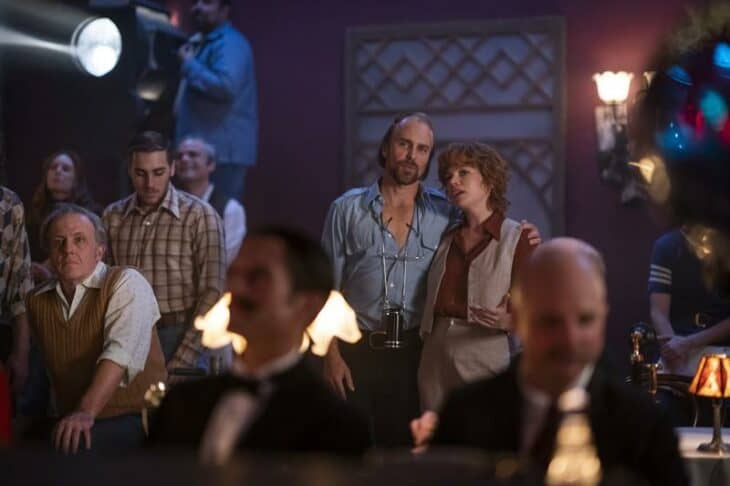
Fosse/Verdon Review: Life is a Cabaret (Season 1 Episode 1)
Fosse/Verdon Season 1 Episode 1 “Life is a Cabaret” has its work cut out for it.
Capturing the sheer scope of the lives of director-choreographer Bob Fosse and actress-dancer Gwen Verdon is no easy task. Both were at the top of their game in theater and film, with Verdon taking home four Tony Awards and Fosse taking home an Oscar, BAFTA, and multiple Emmys.
Their collaboration resulted in some of the most iconic and enduring musicals of all time. You see a bowler hat and a pair of fishnets, and you immediately think “Fosse.”
And therein lies the problem. You immediately think of Fosse but not Verdon.

Fosse/Verdon is trying to change the prevailing narrative that Fosse was the primary genius behind properties like Chicago, Cabaret, and Sweet Charity.
Yes, he was a gifted artist with a choreographic vision and sense of movement that few others could rival, but Verdon, his wife and frequent collaborator, matched him toe for toe (literally and figuratively).
Verdon wasn’t simply a muse; she was an integral, and often uncredited, part of his process.
Early on, the episode proposes that for all of Fosse’s gifts, Verdon may have actually been his secret weapon, helping him edit and clarify his work.
As they work through a choreographic sequence, Fosse physically manipulates and moves Verdon’s body into the exact positions he wants to see. While he steps back to observe, she adjusts, subtly making recommendations that ultimately improve the material. “Yours is better,” he admits while quickly moving on and requesting she work through the sequence again.
The real life Fosse may have been aware but not wholly willing to admit the significant role that Verdon had in shaping his work. One only needs to look at his self-indulgent semi-autobiographical film All That Jazz to guess that humility was not one of his strengths.

However, the team behind Fosse/Verdon, boasting a slew of the creatives behind Broadway hits, Hamilton and Dear Evan Hansen, certainly seems aware of Verdon’s importance in Fosse’s work/his life and appears to want to show that.
Verdon was Fosse’s creative equal, all while consistently providing emotional support and helping translate and clarify his vision to others. At one point in the season opener, Verdon explains “[she] just knows how to speak Bob.”
You see her do this multiple times as she flits around the sets of Cabaret and Sweet Charity, solving problems or explaining Fosse’s intention or vision to a producer or actress who struggles to understand his direction.
Fosse/Verdon attempts to pull Gwen out of the shadows and examine not just the dynamics that comprise creative partnerships — and in Fosse and Verdon’s case, a marriage — but also the reason Verdon’s story is so often minimized.
How does the narrative, in Verdon’s case especially, so often become simplified to one of a woman in the shadows supporting her flawed but genius husband?

In some ways, the show approaches this question in a compelling way. Interestingly, the show roots its first episode around the filming of Cabaret, a critical turning point for Fosse and Verdon.
Cabaret changed Fosse’s career, launching him into the upper echelon of choreographers and directors. At the beginning of their relationship, it was Verdon who had the status and power. With Cabaret, that reverses.
In one scene, Verdon recounts a story where Fosse is referred to as Mr. Verdon by a fan of hers — and there’s a sad sense that’s the last time that will ever happen. The camera lingers on this moment almost as if to signal that.
However, for a show that seems to want to shine a spotlight on Verdon’s contributions and her struggle to remain relevant as Fosse’s reputation and success eclipsed her own, it oddly structures the show around a countdown to Fosse’s death, zooming in and out of different time periods including the sixties, seventies, and eighties.
This vignette structure takes some time to get used to but does help the show’s pacing. With that said, it also feels counterintuitive to the entire enterprise. The show is called Fosse/Verdon, but with the countdown to Fosse’s death, it somehow starts to feel like the overall focus is Fosse.

Michelle Williams, who funnily enough, starred in the recent Broadway revival of Cabaret, is the most compelling reason to watch. As Gwen Verdon, she is simply luminous and pitch perfect, disappearing in the best possible way into the role.
While the writing does not consistently give her a lot to work with, she wrings everything she can out of the material. Scenes with Williams in it — even those without dialogue — are far better than those without.
Despite the strength of Williams’ performance, it’s a disservice to both her and Verdon that there’s not more time spent on Verdon’s motivations and perspective. While that may evolve later in the series, Verdon is often portrayed in moments where she is reacting to Fosse rather than driving action forward herself.
Sam Rockwell is a convincing Bob Fosse and any faults with the show’s depiction of Fosse are less of a reflection of Rockwell and more a frustration with how the show is written.
On this episode, Fosse is cast as a somewhat typical antihero. He loves women and is relentless in his pursuit of them. Frankly, he’s relentless in his pursuit of anything he decides he wants. It’s a story we’ve seen before and not one that I’m particularly eager to see again.

While all of that may be true of Fosse, I am more curious to see the show delve into what it means to be an artist or part of a deeply integrated partnership.
What motivated, haunted, or inspired Fosse and Verdon? How did their commitment to their work add to or disrupt their lives? How did they stay so personally committed to one another even while their marriage faltered in the traditional sense? More of that please.
Frustrations with the show’s focus aside, it is filmed beautifully and the recreations of iconic musical numbers like “Big Spender” are impeccable.
Broadway fanatics will also delight in seeing actresses like Laura Osnes, Bianca Marroquin, and Kelli Barrett pop up as icons Shirley MacLaine, Chita Rivera, and Liza Minnelli respectively. It’s a small treat for those familiar with New York City theater circles.
While this show has a plethora of things to enjoy, I do wonder how much of it may be inaccessible to a normal viewing audience. For example, would most viewers be able to quickly identify and appreciate how well some of the Sweet Charity scenes were recreated? This recognition is half the enjoyment of that scene.

When a sly joke is made about Stephen Sondheim’s next musical, Company, and how it will surely be a flop (spoiler alert: nope, not even close), is that too much of an inside joke to a narrow part of the population?
Is the show relying too much on its audience already being deeply familiar with its protagonists and the world they inhabit, or are they wisely playing to just the right niche?
Overall, it’s a solid start to the series, which will run for a total of eight episodes. There are some clear areas for improvement and character/story development but with two intriguing lead actors and lush production values, there’s a solid foundation on which to build.
What did you think of this episode of Fosse/Verdon and will you be back for an encore? Share your thoughts in the comments below!
Critic Rating:
User Rating:
Fosse/Verdon airs Tuesdays at 10/9c on FX.

Want more from Tell-Tale TV? Subscribe to our newsletter here!
Nicole Fosse Pulls Back the Curtain on Her Parents and Previews ‘Fosse/Verdon’
Cristina Iskander

Cristina is a Broadway enthusiast, book lover, and pop-culture fanatic living in New York City. She once won a Fantasy Bachelor contest (yes, like Fantasy Football, but for The Bachelor), and can banter about old school WB (Pacey + Joey FTW) just as well as Stranger Things and Pen15. She's still upset Benson and Stabler never got together and is worried Rollins and Carisi are headed down the same road, wants justice for Shangela, and hopes to one day walk-and-talk down a hallway with Aaron Sorkin.