
Westworld Review: The Stray (Season 1 Episode 3)
Westworld has finally found its heart on Season 1 Episode 3, “The Stray.”
The best of science fiction engages the audience in an emotional journey that solidly connects them to the utter rawness and heartbreak of being human. So far, Westworld has struggled to define what its vision of humanity is, or even why we should feel for the human creators and park guests that populate its world.
Simply put, while we were shown a vast array of experiences and tragedies that befell the Hosts, we had yet to see a human show a true moment of vulnerability.
Bernard is the one who ultimately opens himself up to the audience as the emotional core of the show. Underneath his morally grey exterior is a man with a burning curiosity to see how far into sentience Ford’s bug can take the Hosts.
Why? Much in the vein of Syfy’s short-lived Caprica (and others that have come before it), Bernard lost a child. It’s a simple twist. It’s not a new one. It’s not even that shocking — but it works.
With the addition of this layer to Bernard, his subterfuge and secret chats with Dolores suddenly have a motive beyond scientific curiosity: if the Hosts can become self-aware, then can he use that technology to bring his son back? Can he erase his pain by giving his son new life?
Dolores the Real Girl
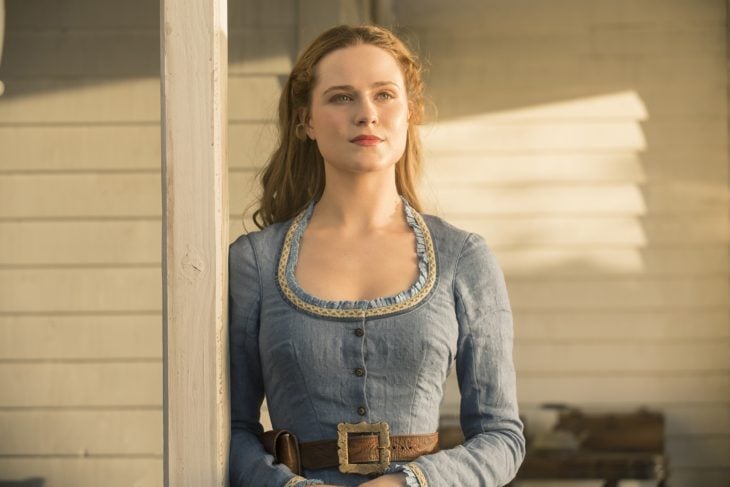
New life also seems to be the path Dolores is set to take, albeit with much less narrative satisfaction.
Three episodes is not much of rebellion arc for a robot realizing its own potential, and yet that is all Dolores is given. While we find out that (perhaps) she was not raped by the Man in Black (and oh, how low the bar is for women at HBO that this revelation is considered a tiny glimmer of hope), we do find out that part of her in-park story is not only to be repeatedly traumatized by the deaths of her parents, but to be dragged off and presumably raped by another Host — that is, should Teddy or another park guest fail to save her.
Dolores gets a shining moment as she overcomes her own programming to shoot the Host preying upon her, but something about her victory feels rushed.
DOLORES: “Dear, dear! How queer everything is to-day. And yesterday things went on just as usual. I wonder if I have been changed in the night?”
BERNARD: Does that passage make you think of anything?
DOLORES: It’s like the other books we’ve read.
BERNARD: How so?
DOLORES: It’s about change. Seems to be a common theme.
We haven’t seen enough of Dolores’ journey, or seen her have a shred of agency. Her storyline revolves around being protected and rescued by various men. When she wishes to buck her programming, it’s to run away with Teddy. Her programming never considered letting her be able to defend herself or shoot guns, as many of the male hosts are permitted to.
Nothing about Dolores’ story stitches together in a cohesive manner. She wants to run, but then she wants to fight. She’s given a slightly different story, but then she winds up back in her old, violent one. Bernard considers taking away her awareness, but then gives it back to her. She uses her skills to overcome her own limitations, but then she experiences some kind of dissociative episode and collapses in William’s arms. All of these events don’t form a full character arc — they’re just little pieces that are often outside of Dolores’ perspective, and all of them occurred in a one hour block.
The symptom here is that Westworld has a Dolores problem. The bigger sickness is this: Westworld has a female problem.
Dolores exists to be victimized and rescued over and over. Maeve exists to sell park goers on the sexual delights her girls can offer them. Clementine exists to be a sexual object.
Sure, Westworld is a “traditional” place, and perhaps the show’s writers are looking to make the park period-accurate. But that only goes so far — period-accurate for Westworld is much closer to the West portrayed in film, not the one that exists in our own history.
There is a lack of imagination in Westworld’s inner story. This same problem befalls Game of Thrones: a world is created to be faithful to an idea of a time period, and thus the problems created for the people that populate it are “traditional” ones (yes, Game of Thrones is a fantasy world, but it is given the trappings of a period piece and is often treated as such). For women, it’s rape, violence, and a fight for any kind of identity outside of their gender. For men, it’s war, guns, adventure, and triumph over one another — often with women as prizes.
This is supposed to be the future. And from what the show has shown us, it is a liberated one: people of all ages and genders are free to express their sexualities as quietly or loudly as they want. We have seen men sleep with men and women sleep with women. The human women like Theresa and Elsie are growing into fully fledged characters with no indication that their stories revolve all around what’s inside their pants.
So, in a society so free from social barriers, why are the female Hosts shackled down with tired tropes to overcome in order to gain their freedom? Why must women escape rape while men go on far-off adventures? Is this actually meant to demonstrate the inherent sexism of Ford and how he designed the park?
Or is this yet another example of the stories writers think “liberates” a woman?
We’ll see.
Stray Thoughts
- Though Westworld continues to have its issues, it is getting more and more enjoyable as the layers of the robotic, sci-fi story are peeled back. Ford’s tale of the creation of the park was nothing short of fantastic, if a little confusing.
- His former partner isn’t really dead, right?
- Who was that badass human cowgirl tagging along with Teddy? I love her. I want more of her. Like, immediately.
- Elsie and the third Hemsworth brother saw some stuff. Are the Hosts committing suicide in order to stop their own glitches from happening?
- Gina Torres! Gina Torres! Gina Torres! Is she coming back? Please can she come back?
- I have a lot of questions this week.
What did you think of this episode of Westworld? Share your thoughts in the comments below!
Reviewer Rating:
User Rating:
Westworld airs Sundays at 9E on HBO.
Brittany Rae

Brittany is a writer and avid TV blogger hailing the infamous year of 1989. She trained at Vancouver Film School in screenwriting for television and film, and has gone on to become a graphic designer and blogger in her free time. When she’s not watching the Food Network, she’s trying to consume every bit of sci-fi television she can get her hands on (current favorites include The 100, Person of Interest, and Doctor Who). She’s always up for female-led dramas and, of course, a literal interpretation of the phrase “Netflix and chill."