
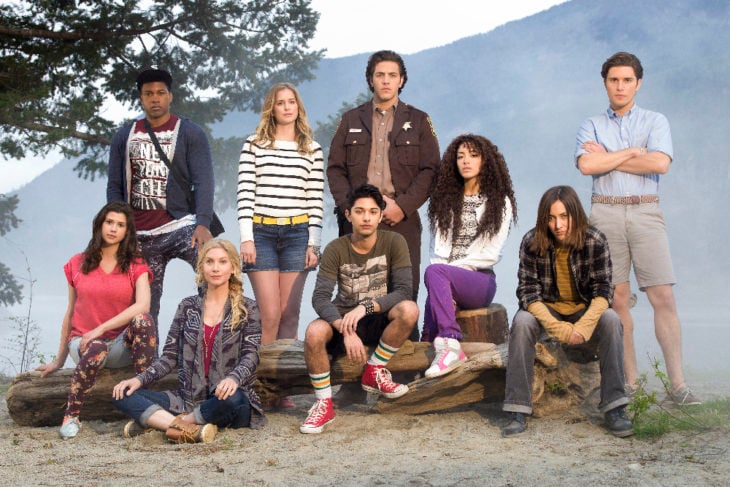
‘Dead of Summer’ Creators Talk ’80s Music, Anthologies, and Bonus ‘Once Upon a Time’ Season 6 Scoop!
We don’t know a lot yet about the specifics of Dead of Summer, the new Freeform series dropping this week, but one thing’s for sure–it’s gonna be spooky and filled to the brim with classic camp rituals.
During ATX Television Festival earlier this month in Austin, I had the opportunity to participate in a roundtable interview with the three men behind the hotly-anticipated series: Lost scribes and Once Upon a Time creators Adam Horowitz and Edward Kitsis, along with their co-creator Ian Goldberg, also a writer for Once Upon a Time.
The trio spoke in detail about what inspired them to set their horror series in a summer camp in 1989, why the anthology format was the way to go, and why their new show is more akin to The Shining than to fellow summer camp classic Friday the 13th. Bonus Once Upon a Time scoop at the end, too!
Check out all the info we’ve got below, and be sure to leave us a comment letting us know what you’re most excited about for Dead of Summer!
It’s Inspired By Their Own Summer Camp Experiences
Anyone looking at the track record of Kitsis and Horowitz, in particular, may have been surprised to see such a sudden and decisive shift into the horror genre, given their most recent creation, Once Upon a Time. But the trio of writers found that the ’80s horror they loved and ’80s teen movies had plenty of overlap.
“We had a love of ’80s horror movies and ’80s teen movies, and if you look at them both you’ll realize they have the same characters, the same archetypes–the jock, the stoner, the cheerleader,” Kitsis said.
The writers also wanted to create a show that was, at its core, about identity, and setting the show at camp seemed like the perfect way to do that.
“The thing we love most about camp is that at camp, no matter what I was in elementary school, at camp I could be who I really wanted to be,” Kitsis continued. “So we wanted to do a show about identity where we took John Hughes meets John Carpenter and put it at summer camp.”
This concept of a genre “mash-up” was something that the writers were really excited about. “Every episode is going to have an iconic camp moment, be it color wars or overnights or just campfires,” Kitsis explained. “It’s going to have iconic teen moments: we’re going to see proms, and parties, and keggers. And then horror moments. So for us that was the fun of it. We like mash-ups.”
It Is Decidedly Not A Slasher
They were exceedingly clear about that fact. Despite its apparent similarities to Friday the 13th, it is very much not that kind of horror. “It looks like Friday the 13th but it is not one person in a mask trying to kill us,” Kitsis said. “It’s much more like The Shining at a summer camp.”
Why The ’80s?
Kitsis explained that there were several reasons for setting the first season in the ’80s. One reason was so that they could include the “Satanic Panic” prominent in the late ’80s in their story.
“It’s set against the Satanic Panic of the late ‘80s. If you’ve ever watched ‘Geraldo,’ you know that there could be Satanists living amongst us.”
He also specified that, while we’ve seen a lot of early ’80s period shows, we hadn’t seen many of the late ’80s, calling it a unique time. “It was kind of the end of one way of living and the beginning of the future, which was the ’90s.”
Horowitz expanded upon the utility of setting the show in the ’80s, citing the timelessness of the story. “There’s an odd phenomenon we found which is that by being in the ’80s, it actually made the show for us feel more timeless,” he explained.
“Being in the present age, it’s almost like you get so caught up in all the technology and the fashion and the current events of the day that it becomes specific to now, but when you go back and strip everything away and you’re at a summer camp, the characters get to be who they are and you can really just focus on that.”
Flashbacks Galore
Given their work on Once Upon a Time and Lost, two series that rely heavily on the narrative use of flashbacks, this shouldn’t be a huge surprise to anyone.
“In the premiere episode, we start to hint with each character that they may all have some kind of secret,” said Horowitz. “We show flashbacks to their lives before camp and we’ll start to see what made them the way they are and who they are and that not everyone is exactly what they present themselves to be.”
Music Plays A Huge Role
Music, and pop culture generally, play a large role in the show, according to the creators. Music was even part of the pitch for the show.
“Throughout the show, there are plenty of references,” Horowitz said. “We don’t want to make it kitschy, and we don’t want to make it obscure. But we want to find the things we loved in that era, things that we think are cool, that we can reintroduce in a way.”
“We said going in [to pitch the show] that music is going to be a very important part of this show, and we want to be able to find those songs that we know from then and introduce a new audience to it.”
While the creators work with a music supervisor, the three of them have a large hand in picking the particular songs that function as the show’s soundtrack, even knowing ahead of time which songs they wanted to feature.
The first episode of the series, which is called “Patience,” features the Guns N’ Roses song of the same name. “‘Patience,’ we always knew we wanted to do ‘Patience.’ Thank god Guns N’ Roses said yes; that was the biggest achievement of my entire career,” joked Kitsis.
Freeform Is The Perfect Fit
Despite ABC Family’s reputation for being more “family-friendly,” its new incarnation, Freeform, is truly living up to its reinvented image with Dead of Summer. “In the pilot, they let us show smoking joints and half-nudity and they really want to push the edge,” Kitsis said.
Freeform was so excited about the new series that Kitsis, Horowitz, and Goldberg ended up landing a straight-to-series order just off of discussing the idea with Freeform execs at a lunch.
“We were very excited about what they want the network to become, so we felt like this was a great place for it,” Kitsis explained.
“I don’t think our audience is watching this show on HBO, I don’t think this audience is watching our show on FX, but I think that this audience might really watch us on Freeform and get what we’re going for. And hopefully it brings in new people to the network, and hopefully we surprise people.”
There Will Be Blood (And ‘Shipping)
“We live in a world of ‘shipping,” Horowitz said, laughing. Notorious for crafting some seriously swoon-worthy (and hotly debated) ‘ships on Once Upon a Time, the creators are no strangers to ‘ship wars. But that’s par for the course for a story about teenagers in a summer camp, so they’re ready for more ‘ship wars, once Dead of Summer drops.
“That’s a part of camp. Camp is where you fall in love, it’s where you have a lot of your firsts, it’s where you get rejected, it’s where I have a crush on you, but you have a crush on him, and he has a crush on you, and it all gets messy by August,” said Kitsis.
Each Character Has Their Day
Much like Lost and Once Upon a Time, the flashbacks contained within each episode will tell the story of one particular character per week. “Every week we’re going to focus on one. So episode 2 is Alex, episode 3 is Cricket, episode 4 is Drew,” explained Kitsis. In the pilot (which was made available to critics prior to ATX), the character of focus for that episode is Amy (played by Elizabeth Lail).
Each Season Is Self-Contained, But Part Of A Larger Story
“One of the fun things about doing a 10-episode summer series, in a way that’s very difficult to do when you’re doing a multi-season show, is we can find a very close-ended story for these characters,” Horowitz noted.
Kitsis expanded on that, explaining the way the show will function, season to season. “The way the show will work is that every year, it’ll be a different year at camp. So this year is 1989. We’re gonna do two flashbacks. We’re gonna see Elizabeth Mitchell’s character Deb reference that she was a counselor in 1970, we’re going to show you a flashback where she was a counselor in 1970, we’re gonna see some of the kids as campers in ’83,” he said.
“So every season will be a different year. So this year’s ’89, but next year might be 2004 or 1970 or 1952. So we can tell a close-ended story the way that Fargo or American Horror Story does.”
While plots specific to the 1989 group will be wrapped up at the end of the current season, larger mysteries will remain.
“The summer of 1989 mysteries are answered and those stories are resolved, but the larger story of what this lake is with these supernatural properties and the camp–we set up this bigger story that hopefully we’ll be able to tell in subsequent seasons in different years,” Horowitz explained.
The camp’s (and the lake’s) dark history will be a focal point of the series. “If you look closely at the sign, the camp was built in 1924, but we also see in the opening to the show that the lake itself–there was stuff going on there in the 1800s that preceded [the camp opening]. So it’s got a long history that starts to reveal itself.”
Bonus: Once Upon a Time scoop!
On the change in format: “We’re going to approach the season a little differently than we have the last few years,” Horowitz explained. “It’s not going to be a ‘Hyde comes to town and the Evil Queen is here and by Christmas it’s all done and we’re on to something new.’ We’re designing a full 22 episode arc for this season.”
On the focus on its Storybrooke crew: “It’s really about focusing in on our characters in Storybrooke and really digging into what’s going on inside of them. Lana as the Evil Queen was the first taste of it–she got split in two, which is gonna allow us to hopefully really explore who she is and the different sides of her, and we want to do that for all the characters. And, without giving anything away too soon, we have ways that we’re doing that for each and every one,” Horowitz said.
Tune in to see the Dead of Summer premiere June 28 at 9/8c on Freeform!
You can also check out all of our coverage of the ATX Television Festival right here. (There is still more to come!)
Caralynn Lippo

Caralynn is a freelance writer and editor, but most importantly, she is a diehard TV addict. A few of her current favorites are Mr. Robot, You're the Worst, iZombie, and The Vampire Diaries. She also writes about TV for Romper, The TV Junkies, and TV Fanatic.