

Quantico and the Question of Gender Roles
In a different time and place, the role of Alex Parrish, the titular character on Quantico, would be played by a man. After all, Alex is not just the hot new recruit at the FBI Academy, no, she’s young, pretty, intelligent, and — get this — the best in her class.
Welcome to a brand new world, ladies and gentleman. We’re not there yet, not really, but every day I’m more and more hopeful.
Before I watched even one second of Quantico , the premise made this seem like just another procedural law-enforcement show. In fact, the only reason I even tuned in the first night was because, unlike most of those procedural dramas, the lead character was a woman, and a minority at that. Let’s give this a chance, I said to myself. It could be different. It could be good.
I didn’t expect it to be both.
We’re not here to talk about Quantico’s many, many strengths. I’m sure that’s been discussed already, and will continue to be discussed in the weeks to come. The show is truly a wonderful example of how you can do edgy television on a big network. But, you know what else the show is a great example of?
Modern, empowered women.

Alex Parrish fills the lead character quota perfectly. She’s smart enough that you want to root for her, secretive enough that you want to learn more and just the right amount of misunderstood. In fact, in setting up the character, the writers treat Alex Parrish the same way they’d treat a male character. And that’s the truly amazing part.
Because, more often than not, television shows have very clear lines on what a male character and a female character are supposed to be like.
Females can be good detectives, yes, but they’ll usually rely more on instinct than on evidence. Males can be good teachers, yes, but if they choose that profession it’s likely because of something dark and mysterious in their past that didn’t allow them to pursue their first career choice. Gender roles on television are a real thing, a pervasive thing, and for all that society in general is slowly moving towards the eradication of them, if you look at television, you wouldn’t think this was happening.
That’s why Alex is so important. You know what I expected her to be? I expected her to be a good recruit, not a great one. I expected her to have hunches, and follow them towards the answer. I’d expect her to sleep with one of the other recruits, because, well, this is television, and sex sells. Romance sells. And in expecting that, I was giving into the assigned gender roles myself. I didn’t know I could expect more – because I’d never been given more.
So, the Alex that actually looks at the evidence and makes an assumption based on what she sees? That Alex was a surprise. The Alex who has sex with a guy in the back of a car only to then announce this in a hallway? That Alex was a delight. The Alex who can make friends with both men and woman? That Alex was a revelation.
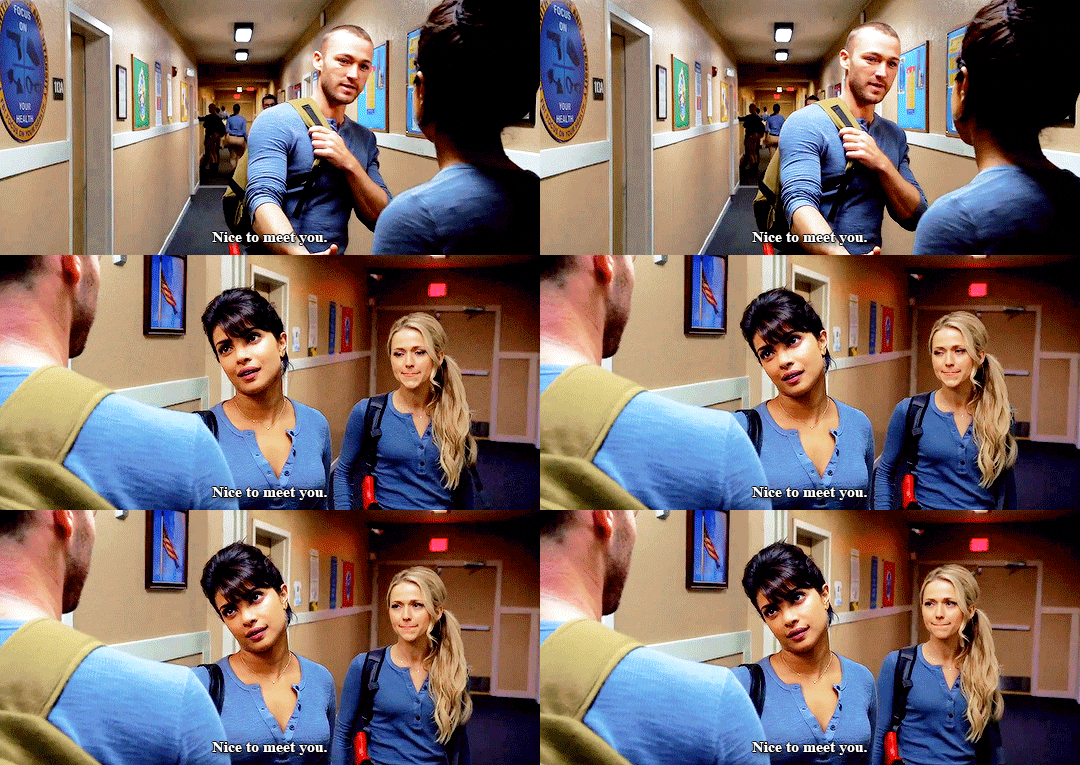
Because women on television are not like Alex. Women on television are not the best recruits on the extremely challenging FBI Academy, they’re not frank and open with their sexuality, and they are especially not conscious of skirting stereotypes.
No, women on television are usually a social construct – a result of the desire to sell. How do you sell a show? Conventional wisdom says that you present a product people are going to relate to. Gender stereotypes are still very much present in our society, and agree with them or not, it’s obvious that most people understand them. So why deviate from what people already understand? Why try to sell something different?
How can you manage to do that and still write a compelling show?
If you’d asked me a month or so ago, I would have told you I didn’t know. I would have said we needed to try, but I wouldn’t have had an answer as to the how.
Now I do. Go watch Quantico.That’s how you do it.
Granted, at this point, we’re just two episodes in. Watch me pontificate about this show only for it to turn everything on its head and become like every show on television. I don’t think this is going to happen, but I understand that it could. Even if it did, though, we’d still have these two episodes. We’d still be able to point at it and say, there, that’s your example. It can be done. It doesn’t take much.

I can’t close this discussion without pointing out that Priyanka Chopra deserves all the accolades she’s getting and possibly even more. It’s not easy to change the status quo, and it’s even harder when you don’t have an actor who can carry out the role that you’ve devised. You can make a character strong on the page, but you can’t make it believable. Only an actor can do that.
Priyanka Chopra passes that test..
The other test Quantico passes? The Bechdel test. And with flying colors. For the uninitiated, the Bechdel test keeps track of whether a work of fiction features at least two women who talk to each other about something other than a man. Two episodes in we’ve already had more than one conversation between Alex and Miranda, Alex and Shelby, and even Alex and Nathalie that had nothing to do with a man.
Pretty low standards, I know. We’re literally giving a show thumbs up for doing something that should be normal, not ground-breaking. It’s ridiculous, you say. It’s not enough, I hear. And that’s true. It’s not. But when we don’t even get that it’s hard to ask for more.
Gender roles are a funny thing. They’re not wrong per se, but after a while, if you adhere strictly to them, they can become oppressive. The world is moving away from that. Television has, so far, stayed behind. But shows like Quantico show that it can be done. It should be done.
And that’s why you need to watch.
Quantico airs Sundays at 10/9c on ABC.
Lissete Lanuza Sáenz

Lawyer. Writer. Columnist. Geek. Falls in madly in love with fictional characters. Hates the color yellow, misogyny, and people who are late. Can always be found with a book. Watches an absurd amount of TV every week, often, while eating coffee ice cream. She has no regrets. You can check out her blog here: Absurday. Lissete is a senior writer for Tell-Tale TV. Follow @lizziethat